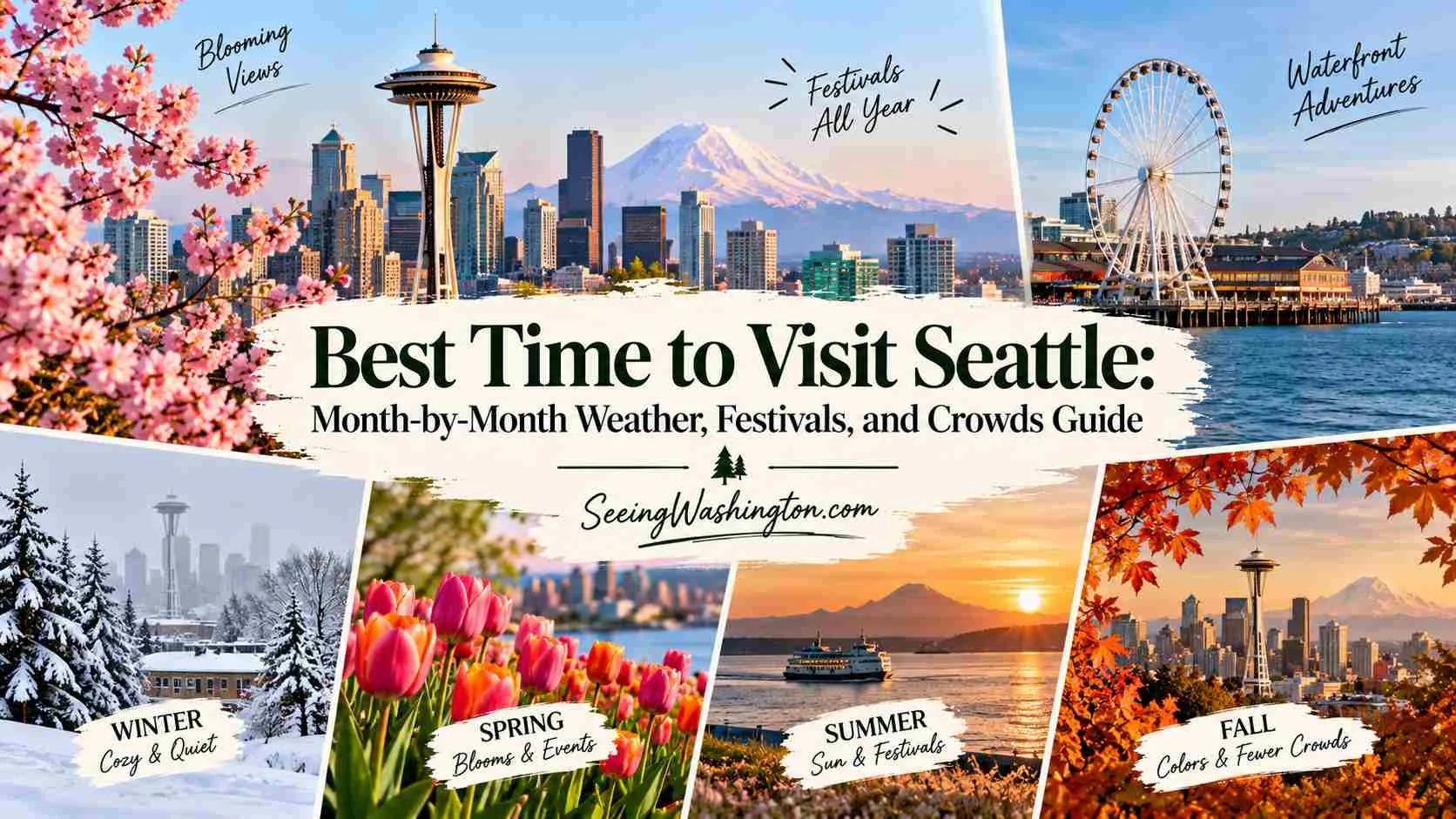
Best Time to Visit Seattle: Month-by-Month Weather, Festivals, and Crowds Guide
Seattle’s reputation is rain — and the reputation is earned from October through April. But the city has a secret season that locals guard fiercely: from mid-June through mid-September, Seattle is one of the most beautiful cities in America. Warm days in the 70s, 15+ hours of daylight, mountain views in every direction, and a festival calendar that fills every weekend. The catch is that everyone else has figured this out too — summer hotel prices double, restaurant reservations require planning, and the Pike Place Market crowd shifts from “bustling” to “sardine can.”
The best time to visit Seattle is mid-June through mid-September for the best weather (70 to 80°F, minimal rain, longest days). The best balance of good weather and fewer crowds is early June or September. The cheapest time to visit is January through March (hotel rates drop 40 to 50%, flights from major cities run $150 to $250 round trip). The worst time for weather is November (the wettest month — 152mm of rain across 19 days). And the city is most authentically itself in October — fall color, crisp air, and the transition from summer energy to indoor-culture season. This guide covers every month with weather data, festivals, crowd levels, hotel prices, and the honest verdict on when Seattle is worth the trip.

Best Time to Visit Seattle: Quick Answer
| Priority | Best Months | Why |
|---|---|---|
| Best overall | Late June–August | Best weather (70–80°F), longest days, all festivals and outdoor activities |
| Best balance | Early June or September | Warm weather, fewer crowds, lower prices than peak summer |
| Cheapest | January–March | Hotel rates 40–50% below summer, flights $150–$250 from major cities |
| Best weather | Mid-July–mid-September | Most reliable sunshine, 70–76°F, only 5–8 rain days per month |
| Fewest crowds | January–February | Lowest tourist traffic, easiest restaurant reservations |
| Worst weather | November–February | Gray, rainy, 40–50°F, 15–19 rain days per month |
| Most authentically Seattle | October | Fall color, crisp air, coffee culture, indoor arts season begins |

Seattle Month-by-Month Guide
January
January is the cheapest month to visit Seattle — hotel rates at top properties drop 40 to 50% below summer peaks, flights from major US cities run $150 to $250 round trip, and restaurant reservations at the city’s best tables are available on 1 to 2 days’ notice instead of 2 to 4 weeks.
The trade-off: gray skies, 45°F average highs, and frequent drizzle (not downpours — Seattle’s rain is a persistent mist that locals barely acknowledge). January Seattle is for museum lovers, coffee drinkers, and people who want to experience the city’s indoor culture without fighting summer crowds.
| Detail | Info |
|---|---|
| Avg. high / low | 47°F / 37°F (8°C / 3°C) |
| Rain days | 18–19 |
| Daylight hours | ~8.5 hours |
| Crowds | Lowest of the year |
| Hotel rates | $150–$300/night (mid-range), 40–50% below summer |
| Best for | Budget travelers, museum lovers, coffee culture, quiet exploration |
February
February brings the first hints of lengthening days but remains firmly in Seattle’s gray season — cool, drizzly, and quiet. The Lunar New Year celebration in the International District and early cherry blossom sightings at the University of Washington campus (late February in warm years) add color. Hotel prices remain low.
| Detail | Info |
|---|---|
| Avg. high / low | 50°F / 38°F |
| Rain days | 15–17 |
| Hotel rates | Low ($150–$300) |
| Best for | Budget travel, early cherry blossoms, Lunar New Year |
March
March is the transition month — rain decreases, temperatures climb to the mid-50s, and the city starts waking up from winter. Cherry blossoms peak at the University of Washington campus (typically mid-to-late March) — one of the best free spring experiences in the Pacific Northwest. Saint Patrick’s Day events add energy.
| Detail | Info |
|---|---|
| Avg. high / low | 54°F / 40°F |
| Rain days | 14–16 |
| Hotel rates | Low to moderate ($175–$325) |
| Best for | Cherry blossoms, shoulder-season pricing, hiking season beginning |
April
April marks the real start of the outdoor season — temperatures reach the upper 50s to low 60s, rain becomes less frequent, and the farmers’ markets and outdoor dining patios open for the season. The Skagit Valley Tulip Festival (1 hour north of Seattle) draws visitors to acres of blooming tulips in every color. Pike Place Market feels energized without summer-level crowds.
| Detail | Info |
|---|---|
| Avg. high / low | 59°F / 43°F |
| Rain days | 12–14 |
| Hotel rates | Moderate ($200–$350) |
| Best for | Tulip festival, outdoor dining, farmers’ markets, moderate crowds |
May
May is when Seattle starts delivering on its promise — mid-60s temperatures, longer days (15+ hours of daylight by month’s end), and the Northwest Folklife Festival at Seattle Center (free music, dance, and cultural performances over Memorial Day weekend).
Farmers’ markets are in full swing. Hiking trails at lower elevations (Rattlesnake Ledge, Twin Falls, Wallace Falls) are snow-free. The rain drops to 8 to 10 days per month — a dramatic improvement from winter. Hotel prices climb but remain below peak summer rates.
| Detail | Info |
|---|---|
| Avg. high / low | 65°F / 49°F |
| Rain days | 8–10 |
| Hotel rates | Moderate to high ($225–$400) |
| Best for | Folklife Festival, hiking, farmers’ markets, pre-summer sweet spot |
June
June is the first truly summer month in Seattle — mostly sunny skies, temperatures in the high 60s to low 70s, and the cultural kickoff of summer with Seafair activities beginning in early June.
Early June (first 2 weeks) offers the best balance of warm weather and pre-peak-season crowds. Hiking trails at higher elevations (Snow Lake, Lake Serene, Mount Si) become accessible. Outdoor festivals, rooftop bars, and waterfront dining reach full swing. The summer solstice (June 20/21) delivers nearly 16 hours of daylight.
| Detail | Info |
|---|---|
| Avg. high / low | 70°F / 53°F |
| Rain days | 6–8 |
| Hotel rates | High ($300–$500) |
| Best for | Best balance of weather and pre-peak crowds, hiking, outdoor dining, Seafair kickoff |
July
July is peak Seattle — the warmest month, the driest month, and the busiest month. Temperatures reach the mid-to-upper 70s (occasionally touching 80s+), rain drops to 3 to 5 days, and every outdoor venue, rooftop bar, and waterfront restaurant operates at full capacity.
Major events: Seafair (hydroplane races, Blue Angels air show, parades), 4th of July fireworks over Lake Union (one of the best fireworks displays in the country), and a packed weekend festival calendar. Hotel rates peak. Restaurant reservations require 2 to 4 weeks’ notice at top spots.
| Detail | Info |
|---|---|
| Avg. high / low | 76°F / 57°F |
| Rain days | 3–5 |
| Hotel rates | Peak ($350–$700+) |
| Best for | Best weather, Seafair, 4th of July, outdoor everything |
August
August continues July’s weather (mid-70s, dry, sunny) with slightly fewer tourists as families shift into back-to-school mode. Bumbershoot music festival (Labor Day weekend, Seattle Center) is the month’s cultural highlight. Wildfire smoke from Eastern Washington and Oregon can affect air quality for 1 to 2 weeks in some years — check air quality forecasts before booking outdoor-intensive trips.
| Detail | Info |
|---|---|
| Avg. high / low | 76°F / 57°F |
| Rain days | 3–5 |
| Hotel rates | High ($325–$600) |
| Best for | Continued summer weather, Bumbershoot, slightly fewer crowds than July |
September
September is the best-value month in Seattle — summer weather lingers (high 60s to low 70s through mid-month), crowds thin dramatically after Labor Day, and hotel rates drop 20 to 30% from peak summer.
The first 2 weeks of September deliver nearly the same weather as August with significantly fewer tourists. By late September, the rain returns and fall begins. This 2-week window is the single best time to visit Seattle for travelers who want warm weather, outdoor access, manageable crowds, and reasonable prices.
| Detail | Info |
|---|---|
| Avg. high / low | 70°F / 53°F (early Sep) dropping to 62°F / 48°F (late Sep) |
| Rain days | 6–8 |
| Hotel rates | Moderate ($225–$400, dropping through the month) |
| Best for | Best overall value, warm weather + fewer crowds, hiking, outdoor dining |
October
October is the most authentically Seattle month of the year — fall color in the parks, crisp air, coffee culture at its coziest, and the transition from outdoor energy to indoor arts season.
The rain returns (10 to 14 days), but many days are crisp and clear with golden light. The Fremont neighborhood’s Oktoberfest and Halloween events add energy. The indoor culture that defines Seattle — coffee shops, bookstores, live music venues, museums, craft breweries — is best experienced when the weather drives you indoors.
| Detail | Info |
|---|---|
| Avg. high / low | 58°F / 46°F |
| Rain days | 10–14 |
| Hotel rates | Moderate ($200–$350) |
| Best for | Fall color, coffee culture, indoor arts, the “real” Seattle experience |
November
November is the worst weather month in Seattle — 152mm of rain across 19 days, only 70 hours of sunshine, and temperatures of 42 to 51°F. Skip November unless you genuinely enjoy gray skies and persistent drizzle. Holiday decorations begin appearing late in the month.
| Detail | Info |
|---|---|
| Avg. high / low | 51°F / 40°F |
| Rain days | 18–19 |
| Hotel rates | Low ($150–$300) |
| Best for | Budget travel only — otherwise avoid |
December
December in Seattle is holiday season — WildLanterns at Woodland Park Zoo, the Winterfest at Seattle Center, Argosy Christmas Ship Festival on the waterfront, and the city’s coziest indoor dining season. The weather is cold (40s) and rainy, but the holiday atmosphere compensates for visitors who embrace it.
| Detail | Info |
|---|---|
| Avg. high / low | 46°F / 37°F |
| Rain days | 17–18 |
| Hotel rates | Low to moderate ($175–$350, rising around Christmas/New Year) |
| Best for | Holiday events, cozy indoor dining, WildLanterns, Argosy Christmas Ships |
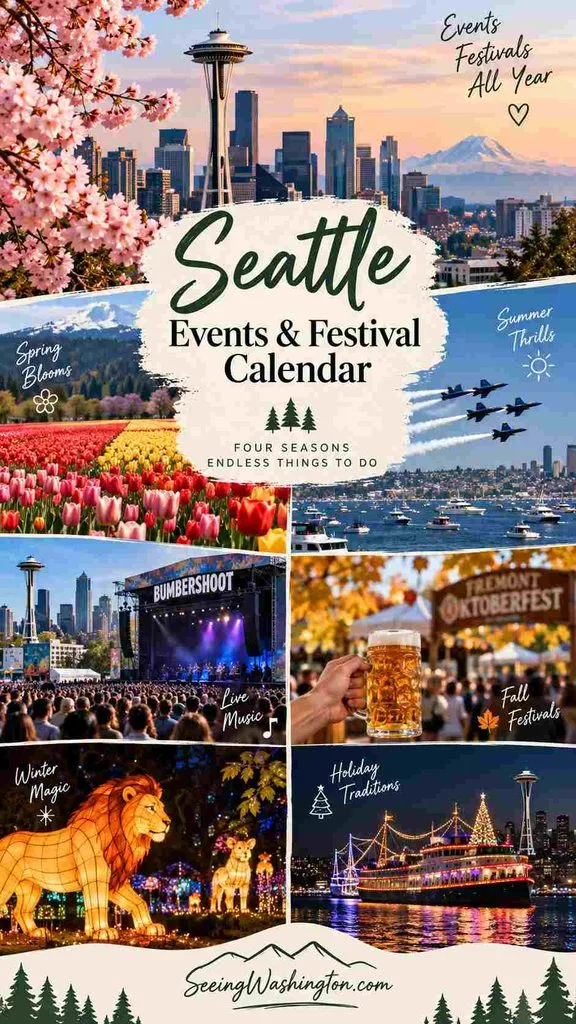
Seattle Events and Festival Calendar
| Event | When | Cost | Highlight |
|---|---|---|---|
| Cherry Blossom Season (UW campus) | Mid-to-late March | Free | 30+ Yoshino cherry trees in the Quad |
| Skagit Valley Tulip Festival | April | $7 per garden | Acres of tulips, 1 hour north |
| Northwest Folklife Festival | Memorial Day weekend (May) | Free | Music, dance, culture at Seattle Center |
| Seafair | June–August (peaks July) | Varies | Hydroplane races, Blue Angels, parades |
| 4th of July (Lake Union) | July 4 | Free | One of the best fireworks in the US |
| Bumbershoot | Labor Day weekend (Sep) | $50–$100/day | Music festival at Seattle Center |
| Fremont Oktoberfest | September | Free entry | Beer, bratwurst, live music |
| WildLanterns | November–January | $25–$35 | Lantern displays at Woodland Park Zoo |
| Argosy Christmas Ship Festival | December | Free (from shore) / $50+ (boat) | Illuminated ships, caroling on the water |
Booking Tips for Your Seattle Trip
Smart booking timing can save hundreds on a Seattle trip.
- Flights: Book 6 to 8 weeks before summer travel, 2 to 4 weeks before winter travel. Seattle-Tacoma International Airport (SEA) has direct flights from most major US cities. January and February offer the cheapest fares ($150 to $250 round trip from LAX, ORD, JFK).
- Hotels: Summer rates (June–August) run $350 to $700+/night at top properties. Winter rates drop to $150 to $300. The best value window is the first 2 weeks of September — summer weather at shoulder-season prices.
- Restaurants: Top restaurants (Canlis, The Walrus and the Carpenter, Bateau) require 2 to 4 weeks’ notice in summer. In winter, walk-in availability is common.
- Protect your booking research: When comparing hotel and flight prices across multiple travel sites, a vpn can prevent dynamic pricing algorithms from tracking your searches and inflating prices based on repeat visits — a well-documented practice among some online travel agencies and airline booking systems.
What to Pack for Seattle by Season
| Season | What to Pack |
|---|---|
| Summer (Jun–Sep) | Light layers (t-shirt + light jacket), sunglasses, sunscreen, comfortable walking shoes, 1 rain layer (just in case) |
| Fall (Oct–Nov) | Rain jacket (essential), layers, sweater or fleece, waterproof shoes, umbrella |
| Winter (Dec–Feb) | Rain jacket, warm layers, waterproof boots, umbrella, hat and gloves |
| Spring (Mar–May) | Rain jacket, layers, waterproof shoes — weather swings from sun to rain within hours |
The Seattle rain truth: Seattle gets about 37 inches of rain per year — less than New York (47 inches), Houston (50 inches), or Miami (62 inches). The difference is frequency, not volume. Seattle’s rain is a persistent, light drizzle that falls across 150+ days per year. Locals don’t use umbrellas — they wear waterproof jackets and keep walking.
Best Time to Visit Seattle: Frequently Asked Questions
What is the best month to visit Seattle?
July is the best single month for weather (76°F average high, 3 to 5 rain days, longest daylight). For the best balance of weather, crowds, and price, the first 2 weeks of September or early June are ideal — summer conditions with 20 to 30% lower prices and significantly fewer tourists.
What is the cheapest time to visit Seattle?
January through March offers the lowest hotel rates (40 to 50% below summer) and cheapest flights ($150 to $250 round trip from major cities). The trade-off is gray, rainy weather with temperatures in the mid-40s to mid-50s.
Does it really rain all the time in Seattle?
No — Seattle gets only 37 inches of rain per year (less than NYC, Houston, or Miami). The perception comes from the frequency — 150+ days with some measurable precipitation. But the rain is light drizzle, not heavy downpours. Summer (June through September) averages only 3 to 8 rain days per month.
When is Seattle’s rainy season?
October through April, with November being the wettest month (152mm of rain across 19 rain days). May through September is the dry season, with July and August averaging only 3 to 5 rain days each.
Is Seattle worth visiting in winter?
Yes — if you embrace indoor culture. Seattle’s museums (Museum of Pop Culture, Seattle Art Museum, Museum of Flight), coffee shops (the city has the most per capita in the US), craft breweries, bookstores (Elliott Bay Book Company), and live music venues are all at their best in winter. Hotel prices are 40 to 50% lower. Restaurant availability is significantly better. You just won’t see the sun much.
How many days do you need in Seattle?
3 to 4 days is ideal. Day 1 for Pike Place Market, the waterfront, and downtown. Day 2 for neighborhoods (Capitol Hill, Fremont, Ballard) and the Museum of Pop Culture. Day 3 for a day trip (Mount Rainier, San Juan Islands, or the Olympic Peninsula). Day 4 for deeper exploration — Discovery Park, kayaking on Lake Union, or a brewery crawl.
When can you see Mount Rainier from Seattle?
July through September offers the highest probability of clear views of Mount Rainier from Seattle. The 14,411-foot volcano is visible from dozens of locations around the city on clear days — but clouds, haze, and overcast skies hide it for much of the year. Clear winter days also offer dramatic views of the snow-covered mountain.
Final Thoughts
The best time to visit Seattle depends on what you want from the city. July and August deliver the weather that postcards promise — 76°F, dry, sunny, and alive with festivals, rooftop bars, and 16 hours of daylight. September delivers nearly the same weather with half the crowds and 20 to 30% lower prices. October delivers the city at its most authentic — fall color, coffee culture, and the indoor arts scene that the rain built. And January delivers the cheapest trip, the emptiest restaurants, and a Seattle that belongs entirely to the people who live there.
The photographs show July. The city is most itself in October. The best value is September. The cheapest flights are in January. All of these are true. Choose accordingly.
Pack a rain jacket regardless of the month — not because it will definitely rain, but because Seattle respects the people who come prepared. Walk Pike Place Market. Drink the coffee. Watch for Mount Rainier on clear mornings. Ride the ferry to Bainbridge Island at sunset. And when someone back home asks about the rain, tell them the truth: it rains less in Seattle than in New York. It just does it more often. And when the sun comes out — which it does, gloriously, from June through September — Seattle is one of the most beautiful cities in America. The locals know this. Now you do too.