
Seattle to San Diego Drive: The Ultimate West Coast Road Trip Guide
Road trips have a special place in American culture, and great road trips don’t come bigger than driving the full length of the West Coast. I’ve done the Seattle to San Diego drive twice — once down Interstate 5 (I-5) in a rushed 3 days, and once over 8 days along Highway 101 and the Pacific Coast Highway (Highway 1) in a Mustang convertible I rented specifically for the occasion. The coastal route turned out to be one of the great travel experiences of my life, and I say that as someone who grew up reading Road Trip USA and dreaming about Route 66.
The Seattle to San Diego drive is approximately 1,255 miles via Interstate 5 and takes about 19 hours of nonstop driving. The scenic coastal route via Highway 101 and Highway 1 (Pacific Coast Highway) stretches to roughly 1,590 miles and takes 30 to 32 hours behind the wheel. Plan 3 days minimum for I-5 and 7 to 10 days for the coastal drive. Both routes pass through 3 states: Washington, Oregon, and California.
This guide covers both routes, a day-by-day coastal itinerary, the best stops, realistic costs, seasonal conditions, and the honest logistics I’ve learned. The Seattle to San Diego drive is the Great American road trip — the full West Coast from the Pacific Northwest to the Mexican border. Here’s how to do it right.
Seattle to San Diego Distance Drive and Time
The driving distance from Seattle to San Diego is approximately 1,255 miles via I-5, with a drive time of roughly 19 hours without stops.
That 19-hour estimate assumes no traffic, no construction, and no stops. Real-world driving adds 2 to 4 hours for gas, food, and the inevitable slowdowns through Sacramento and the Los Angeles metro area. LA alone can add an hour depending on time of day — the stretch of I-5 through Orange County into San Diego is one of the most congested corridors in the United States.
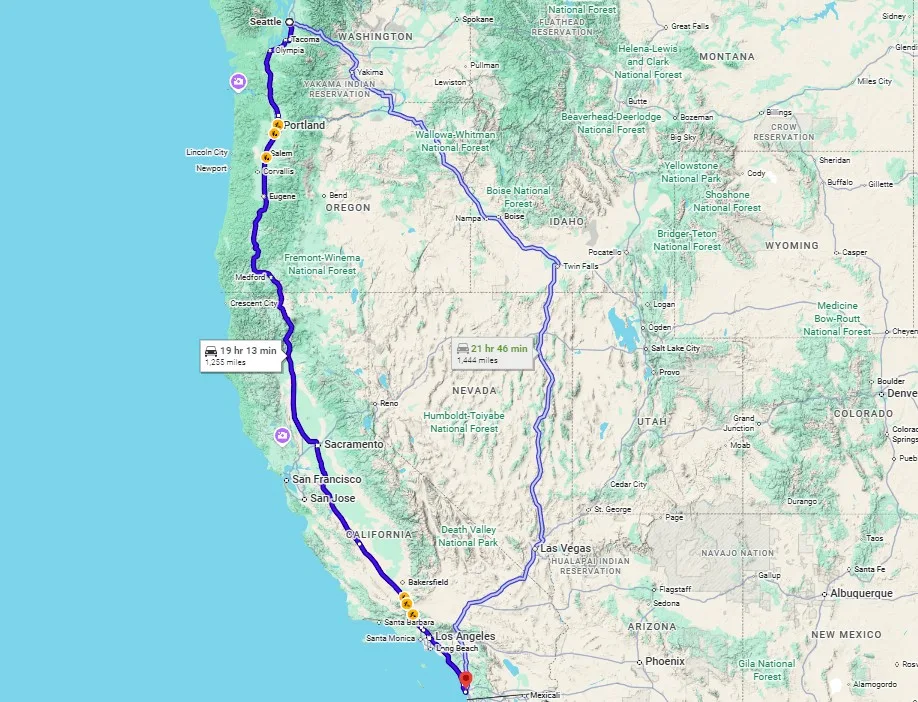
Seattle and San Diego share the Pacific time zone, so no clock adjustments needed.
Here’s the I-5 distance breakdown:
| Segment | Distance | Drive Time |
|---|---|---|
| Seattle to Portland, OR | 175 miles | 3 hours |
| Portland to Grants Pass, OR | 250 miles | 4 hours |
| Grants Pass to Redding, CA | 180 miles | 3 hours |
| Redding to Sacramento, CA | 160 miles | 2.5 hours |
| Sacramento to Los Angeles, CA | 390 miles | 6 hours |
| Los Angeles to San Diego, CA | 120 miles | 2 hours |
Practical info:
- Main highway: Interstate 5 (I-5) for the entire direct route
- States crossed: Washington, Oregon, California
- Gas cost: Roughly $65 to $100 one-way (1,255 miles at 28 mpg, $3.50 to $5.00/gal)
- Best season: June through October for clear roads on all routes
- Tip: Gas prices jump significantly once you cross into the Golden State — fill up in Grants Pass or Medford, Oregon before the state line
My honest take: I-5 from Seattle to San Diego is 19 hours of freeway. It works for relocations, and it works if you’re in a hurry. But the stretch between Sacramento and LA through California’s Central Valley is 6 hours of flat, hot nothing. I did it once and spent the entire time thinking about the Oregon Coast I was missing 200 miles to the west. If you have more than 3 days, take the coast.
The 2 Best Routes from Seattle to San Diego
2 main routes connect Seattle to San Diego: Interstate 5 (fast and direct) and Highway 101 / Pacific Coast Highway (Highway 1) for the coastal scenery.
Route 1: Interstate 5 (The Direct Route)
I-5 runs the entire length of the US West Coast. You get on in Seattle, drive south through Portland, Sacramento, LA, and get off in San Diego. The road is well-maintained, gas stations are frequent, and the drive is functional. Major city stops include Portland (3 hours from Seattle), Sacramento (9.5 hours), and Los Angeles (17 hours).
The I-5 route is the choice for anyone relocating, anyone with tight schedules, or anyone who just needs to get to Southern California. It’s not scenic outside of southern Oregon (the Siskiyou Pass and views of Mount Shasta are genuine highlights).
Distance: ~1,255 miles | Drive time: ~19 hours | Best for: Speed, efficiency, relocations
Route 2: Highway 101 + Pacific Coast Highway (Highway 1)
This is the drive that earns a spot on every “best road trips in the world” list. You take I-5 south from Seattle to Olympia, then pick up Highway 101 along the Washington and Oregon coasts. In Northern California, Highway 101 takes you through the Redwood Forests and the Avenue of Giants. South of San Francisco, Highway 1 (the Pacific Coast Highway) hugs the California coast through Big Sur, Santa Barbara, Malibu, and LA. From LA, I-5 or I-15 takes you the final 120 miles into San Diego.
The coastal scenery is unmatched — hundreds of miles of Pacific Ocean views, coastal drives through small towns, national parks, and state parks. The trade-off: the route is roughly 1,590 miles, takes 30 to 32 hours of driving, and requires 7 to 10 days to do properly.
Distance: ~1,590 miles | Drive time: ~30 to 32 hours | Best for: Scenic road trip lovers, photographers, anyone with a week or more
Practical info:
- I-5 advantages: Fast, predictable, well-serviced
- Highway 101 / PCH advantages: Best coastal scenery in the US, national parks, charming towns
- Highway 1 closures: Sections near Big Sur close frequently for landslides — check Caltrans before planning
- Tip: Use Roadtrippers (app/website) to map your stops along either route. GasBuddy helps find the cheapest gas stations. Waze handles real-time traffic routing better than Google Maps on the LA stretch.
My honest take: The coastal route is one of the great road trips in the world. I’m not exaggerating. I’ve driven through Arizona on Route 66, I’ve explored New Zealand’s South Island, and the Pacific Coast Highway from Oregon through Big Sur still ranks at the top. If you have 7 to 10 days, hit the road on Highway 101 and don’t look back. If you only have 3 days, fly to San Diego — the I-5 sprint isn’t worth the gas money when flights cost $100 to $200.
Day-by-Day Itinerary: Seattle to San Diego in 8 Days (Coastal Route)
An 8-day itinerary follows Highway 101 and the Pacific Coast Highway with 4 to 6 hours of driving per day and time at every major stop.
Day 1: Seattle to the Oregon Coast — Seaside, OR (280 miles, ~5 hours)
Leave Seattle on I-5 South. Before you leave town, consider a quick stop at the Boeing Factory in Everett — the world’s largest building by volume, 25 miles north of downtown Seattle. If you’re flying into Seattle Airport and starting from there, you’ll pass right by it. Head south through Olympia and cut west toward the coast. The drive crosses into Oregon and lands you on Highway 101 at the coast.
Seaside is a classic Pacific Northwest beach town — saltwater taffy shops, a boardwalk, and wide sandy beach. It’s low-key and perfect for a first-night stop after a long departure day.
Day 2: Seaside to Newport, OR (140 miles, ~3.5 hours)
Head south on Highway 101 along the Oregon Coast. Stop in Tillamook for the Tillamook Creamery — the cheese factory tour is free and the ice cream is some of the best in Oregon. Continue south through Lincoln City to Newport. The Oregon Coast between Tillamook and Newport is dramatic — rocky headlands, tide pool ecosystems visible at low tide, and coastal towns with genuine character.
Newport has the Oregon Coast Aquarium and a working bayfront with fishing boats, chowder houses, and sea lions barking on the docks. Budget a full evening.
Day 3: Newport to the Redwoods — Crescent City, CA (340 miles, ~6.5 hours)
This is the longest driving day. Continue south on Highway 101 through Eugene (cut inland briefly on I-5 through Eugene, then rejoin 101 south of Grants Pass) and into Northern California. The southern Oregon coast is wild — fewer people, bigger waves, steeper cliffs.
Cross into California and enter Redwood country. The Redwood Forests along Highway 101 in Northern California contain the tallest trees on Earth. Pull into Crescent City for the night. The Avenue of the Giants (a 31-mile scenic road through old-growth Redwoods south of here) is tomorrow’s first stop.
Day 4: Crescent City to Fort Bragg, CA (230 miles, ~5.5 hours)
Drive the Avenue of the Giants through towering Redwoods — some trees are over 350 feet tall and 2,000 years old. Stop at a drive-through tree if you want the full American road trip tourist experience (my sister made me do it as a teenager and I pretended to hate it, but it’s genuinely fun).
Continue south on Highway 101 through Eureka and into the Lost Coast region. Cut over to Highway 1 at Leggett and follow it south to Fort Bragg. Fort Bragg is a small coastal town with Glass Beach — a beach covered in sea glass from an old dump site that the ocean has smoothed and polished over decades.
Day 5: Fort Bragg to San Francisco, CA (175 miles, ~4 hours)
Highway 1 from Fort Bragg to San Francisco is winding, dramatic, and slow — exactly the kind of coastal drive this trip is about. The road clings to cliffs above the Pacific, passing through small towns like Mendocino, Point Arena, and Bodega Bay.
Cross the Golden Gate Bridge into San Francisco. Spend the rest of the day and evening in the city. San Francisco is expensive but worth at least one full night. I covered the highlights in my Seattle to Los Angeles guide — the Golden Gate Bridge, Fisherman’s Wharf, and Chinatown are the essentials.
Day 6: San Francisco to Big Sur / San Simeon, CA (250 miles, ~5.5 hours)
Head south through Monterey on Highway 1. South of Monterey, the Pacific Coast Highway enters Big Sur — 90 miles of the most dramatic coastal road in the United States. Bixby Creek Bridge, McWay Falls, and Julia Pfeiffer Burns State Park are the highlights. No cell service. No gas stations for long stretches. Pack food and water.
Continue to San Simeon or Cambria for the night.
Day 7: San Simeon to Los Angeles, CA (235 miles, ~4.5 hours)
Highway 1 continues south through Morro Bay and San Luis Obispo, reconnecting with Highway 101 for the run into Southern California through Santa Barbara, Ventura, Malibu, and Santa Monica. Arriving in LA from the coast via Malibu is cinematic — the Pacific stretches out on your right as the LA skyline slowly appears.
Spend the evening in LA. Walk the Santa Monica Pier. Eat somewhere good. You’ve earned it.
Day 8: Los Angeles to San Diego, CA (120 miles, ~2 to 3 hours)
The final stretch. Take I-5 South from LA through Orange County to San Diego. With traffic, this drive can take 3 hours. Without traffic (weekend mornings work best), it’s 2 hours.
San Diego greets you with perfect weather, a beautiful harbor, the Gaslamp Quarter, and Balboa Park. You’ve just driven the entire West Coast of the United States — from the rain and evergreen forests of Seattle to the sunshine and palm trees of San Diego.
My honest take: Day 6 (San Francisco to Big Sur) is the peak of this entire drive. I rented a Mustang convertible for this stretch — a top-down cruise along Big Sur’s cliffs with the ocean below and the mountains above. It was worth every penny of the rental upgrade. If there’s one day to splurge on the car, it’s this one. A mate of mine who’d driven all over the world called it “the best 90 miles of road on Earth.” I wouldn’t argue.
Best Stops Between Seattle and San Diego
The 10 best stops on the Seattle to San Diego drive are Portland, the Oregon Coast, Crater Lake (detour), the Redwood Forests, San Francisco, Monterey, Big Sur, Santa Barbara, Los Angeles, and Mount St. Helens (detour).
Mount St. Helens (Detour from I-5)
Mount St. Helens erupted in 1980 and reshaped 230 square miles of forest. The Johnston Ridge Observatory offers a direct view into the crater. The detour is 50 miles east of I-5 from Castle Rock, WA. Budget 3 to 4 hours. The landscape is still recovering — eerie and fascinating. I wrote about the volcano in my Seattle to Portland guide.
Portland, OR
Portland is 175 miles south of Seattle on I-5. Portland’s food cart scene, craft breweries, and Washington Park (home to the Portland Japanese Garden and the International Rose Test Garden) make it worth an overnight.
Oregon Coast (Highway 101)
363 miles of publicly accessible coastline. Seaside, Tillamook, Newport, and Bandon are the standout towns. Tide pool ecosystems are visible at low tide near Yachats. Whale watching excursions run out of Newport and Depoe Bay from December through April.
Redwood Forests / Avenue of the Giants
The Redwood Forests of Northern California contain the tallest trees on the planet. The Avenue of the Giants is a 31-mile scenic drive through old-growth groves. National park status protects large sections. Budget 2 to 4 hours for walking and driving.
San Francisco, CA
Roughly halfway on the coastal route. The Golden Gate Bridge, Fisherman’s Wharf, Alcatraz, Chinatown, and Golden Gate Park. Budget 1 to 2 full days. Hotels average $200 to $300/night.
Monterey, CA
Gateway to Big Sur. Monterey Bay Aquarium is world-class. 17-Mile Drive through Pebble Beach is scenic but costs $10 in toll. Cannery Row has waterfront restaurants.
Big Sur, CA
90 miles of Pacific Coast Highway cliffside road. Bixby Creek Bridge, McWay Falls, Pfeiffer Beach. No cell service. No gas stations. Pure coastal scenery. The highlight of any West Coast road trip.
Santa Barbara, CA
Spanish colonial architecture, beaches, and the Funk Zone wine-tasting district. One of the prettiest coastal cities in California. Budget at least a lunch stop.
Los Angeles, CA
LA deserves at least one overnight on the Seattle to San Diego drive. The Santa Monica Pier, Venice Beach, Griffith Observatory, and the Hollywood Sign hike are the essentials. Traffic is brutal — avoid arriving between 4 and 7 p.m.
San Diego, CA
Your destination. Balboa Park, the San Diego Zoo, the Gaslamp Quarter, and La Jolla Cove are the highlights. The weather is perfect year-round — mid-60s to mid-80s, low humidity, sunshine.
My honest take: The Oregon Coast and Big Sur are the 2 sections that make this a world-class road trip. Everything else is great, but those stretches are why people from New Zealand, Europe, and across the world put this drive on their bucket list. If you skip the coast and take I-5, you’re missing the entire point.
Seattle to San Diego Drive: Budget Breakdown
An 8-day Seattle to San Diego coastal road trip costs roughly $1,500 to $2,800 for a solo driver and $1,800 to $3,200 for 2 people, covering gas, lodging, food, and activities.
| Expense | I-5 Route (3 Days) | Coastal Route (8 Days) |
|---|---|---|
| Gas | $65 to $100 | $90 to $140 |
| Lodging | $200 to $400 (2 nights) | $800 to $1,600 (7 nights) |
| Food | $60 to $120 | $250 to $500 |
| Activities/parks | $20 to $50 | $60 to $200 |
| Total | $345 to $670 | $1,200 to $2,440 |
Gas prices across the 3 states: Washington averages $3.50 to $4.50/gallon, Oregon runs $3.50 to $4.00, and California ranges from $4.50 to $5.50+ (higher on the coast). Use GasBuddy to find the cheapest stations along your route. Oregon requires attendants to pump your gas at most stations.
One-way rental car fees add $100 to $300 for a Seattle pickup / San Diego drop-off. AAA (American Automobile Association) membership gives you roadside assistance and hotel/restaurant discounts along the route — worth it for a drive this long.
Practical info:
- Cheapest gas: Oregon
- Most expensive gas: California coast
- Campgrounds option: National forest campgrounds and state parks along Highway 101 run $10 to $35/night — a budget-friendly alternative to hotels. RV parks are also available along the entire route for those traveling by campervan.
- Tip: The cost to drive from Seattle to San Diego is higher than flying (round-trip flights run $100 to $250). You’re paying for the experience of driving the full West Coast, not for transportation savings.
My honest take: California hotel prices are what make this trip expensive. San Francisco ($250/night), LA ($150 to $200/night), and even small coastal towns ($120 to $180/night in summer) add up fast. I saved money by camping 3 of my 7 nights on the Oregon Coast and in the Redwoods — state parks with ocean views for $25/night. The drive itself is affordable. The sleeping is where budgets break.
Driving Conditions and Best Times to Travel
The best time to drive Seattle to San Diego is June through early October, when coastal roads are clear and weather is best across all 3 states.
Summer (June to September)
Peak road trip season. Highway 101 and Highway 1 are fully open. Oregon Coast mornings start foggy but clear by midday. California coast is warm (70s). California’s Central Valley on I-5 is brutally hot (100°F+ in July and August). San Diego is perfect — 75 to 85°F, zero rain.
Fall (October to November)
My pick. Lighter crowds, warm Southern California, clear skies, and fall color in Oregon. Highway 1 is still open through October in most years. Rain increases in the Pacific Northwest by late October. Watch for northern California wildfire season (late August through October) which can affect air quality and road closures.
Winter (December to March)
I-5 stays open year-round but Siskiyou Pass near the Oregon-California border can get snow and ice. Highway 101 stays open but the Oregon Coast is rainy, cold, and storm-battered. Highway 1 through Big Sur has the highest closure risk from landslides. Driving from Seattle to San Diego in winter is doable on I-5 but not recommended on the coastal route.
Spring (April to May)
Wildflowers bloom across California. Highway 1 may have winter closures lingering into April. The Oregon Coast is rainy but green. May is the sweet spot — most roads open, flowers peak, summer crowds haven’t arrived.
My honest take: Late September. The Oregon Coast has its clearest weather. Big Sur is fully open. California is warm. San Diego is perfect. Summer crowds have thinned. I drove in late September and had Big Sur practically to myself on a Tuesday morning. Born in the USA was playing on the radio. The top was down. I’m not a sentimental person, but that morning stays with me.
6 Things I’ve Learned Driving Seattle to San Diego
1. Highway 1 closures are frequent and real. Check dot.ca.gov before you plan your Big Sur day. I had to reroute through the Central Valley on my first trip because a landslide closed 30 miles of Highway 1. Have a backup plan.
2. Fill your tank before entering California. Gas jumps $0.50 to $1.00/gallon at the state line. The last affordable gas is in Grants Pass or Medford, Oregon.
3. LA traffic will eat your schedule. Never plan to arrive in or depart LA between 4 and 7 p.m. on a weekday. I lost 90 minutes crawling through Orange County on a Wednesday afternoon. Time your LA segment for morning or late evening.
4. The Oregon Coast has no cell service in long stretches. Download offline Google Maps before you leave Portland. Several sections of Highway 101 between Newport and Brookings are dead zones.
5. Bring layers for the entire coast. Even in July, the Oregon Coast stays in the 50s and 60s. Northern California coast is similar. Southern California warms up, but Big Sur mornings can be chilly with fog. I packed for a beach vacation and wore a jacket for 5 of my 8 days.
6. Is there a train from Seattle to San Diego? Sort of. Amtrak’s Coast Starlight runs Seattle to LA (35 hours), and the Pacific Surfliner connects LA to San Diego (3 hours). Total train time is roughly 38 to 40 hours with a transfer in LA. How long is the train ride from Seattle to San Diego? Plan about 2 full days. It’s not faster than driving, but it’s a different experience — sleeper cars, a dining car, and some coastal sections that the highway doesn’t reach.
Seattle to San Diego Drive: Frequently Asked Questions
How long is the drive from Seattle to San Diego?
The drive from Seattle to San Diego takes approximately 19 hours via I-5 without stops. With gas, food, and rest breaks, plan 21 to 23 hours of total travel time. The scenic coastal route via Highway 101 and Highway 1 takes 30 to 32 hours of driving.
How far is it from Seattle to San Diego by car?
The distance from Seattle to San Diego by car is approximately 1,255 miles via I-5. The coastal route via Highway 101 and Highway 1 is roughly 1,590 miles.
Can you drive from Seattle to San Diego?
Yes — the drive is entirely on well-maintained US highways. I-5 runs directly from Seattle to San Diego. The coastal alternative follows Highway 101 and Highway 1. Both routes pass through Washington, Oregon, and California with frequent gas stations, rest stops, and lodging.
What is the scenic drive from Seattle to San Diego?
The scenic coastal drive follows Highway 101 South along the Oregon Coast and Highway 1 (Pacific Coast Highway) along the California coast through the Redwood Forests, San Francisco, Big Sur, Santa Barbara, and Malibu. This route is roughly 1,590 miles and takes 7 to 10 days to do properly.
How many hours does it take to drive from Seattle to San Diego?
Approximately 19 hours nonstop on I-5, or 30 to 32 hours on the coastal route. Most people split I-5 across 3 days and the coastal route across 7 to 10 days.
What is the best time to drive from Seattle to San Diego?
Late September or early October. Coastal roads are clear, Big Sur is open, California is warm, Oregon has its best weather, and summer crowds have thinned. Avoid December through March for the coastal route (rain, storms, Highway 1 closures).
What does the Seattle to San Diego drive cost?
Gas costs roughly $65 to $100 on I-5 and $90 to $140 on the coastal route. Total trip cost including lodging and food ranges from $350 to $670 for the 3-day I-5 sprint and $1,200 to $2,400 for the 8-day coastal road trip.
Final Thoughts
I moved to Seattle in 2018 and started exploring this city immediately — the neighborhoods, the waterfront, the sunsets from Kerry Park. Seattle became home fast. But driving south from Seattle along the West Coast — watching the landscape shift from evergreen forest to Oregon’s rocky shores to California’s Redwood Forests to Big Sur’s cliffs to San Diego’s palm trees — gave me a sense of the American West Coast that 8 years of living here couldn’t.
The Seattle to San Diego drive is the full West Coast, top to bottom. Rain to sunshine. Coffee culture to surf culture. Evergreen to neon. It crosses 3 states, 1,255 miles of interstate or 1,590 miles of coastal highway, and every mile changes the light, the temperature, and the character of the towns you pass through.
I’ve traveled to the Phi Phi Islands, the Great Sand Dunes, the Badlands, and Yosemite. The Seattle to San Diego coastal drive belongs on that list. Not for one single jaw-dropping moment, but for the cumulative effect of 8 days watching one coastline — the same Pacific Ocean — transform from wild and cold in Oregon to dramatic and rugged in Big Sur to warm and gentle in San Diego.
Take the coast. Take 8 days. Rent a convertible for at least one day. Stop at every overlook. And when you arrive in San Diego, stand on the beach at La Jolla Cove and look north — the entire West Coast stretches behind you, and you just drove it.


