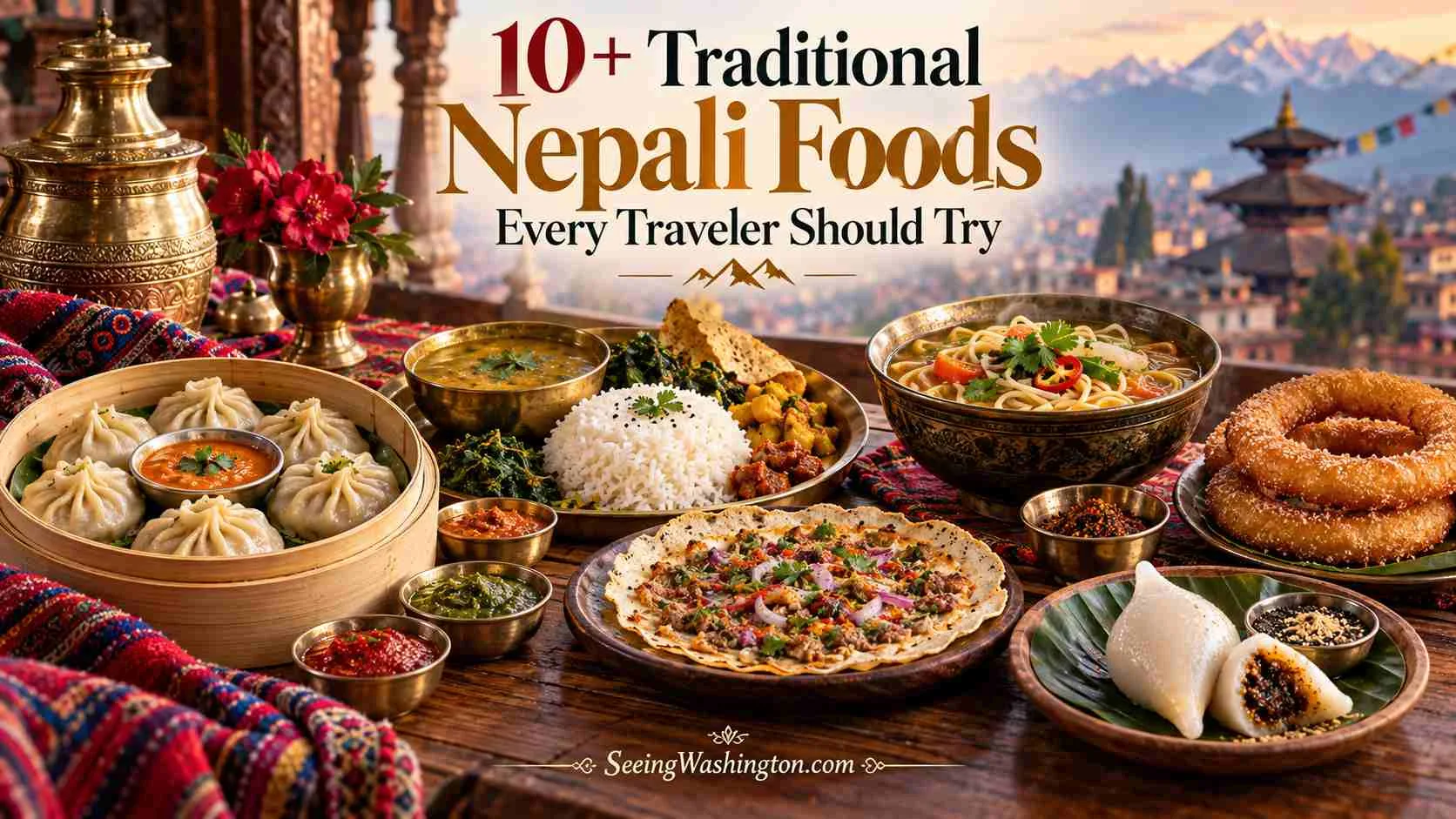
10+ Traditional Nepali Foods Every Traveler Should Try
There is a moment on every trip to Nepal when the mountains stop being the only thing on the mind. It usually happens somewhere between the first steaming plate of momos and a second helping of dal bhat that arrives before anyone has even asked for it.
Nepali food is warm, filling and closely tied to the seasons, the festivals and the long days of mountain life. Nothing about it is fussy. Some of the most memorable meals come from a small family kitchen, a busy roadside stall or a teahouse halfway up a trail.
For travelers who want to taste the country rather than simply pass through it, Nepal has plenty waiting on the plate.
1. Dal Bhat
Dal bhat is the heart of everyday Nepali eating and the meal most locals sit down to twice a day. A plate brings steamed rice with lentil soup, seasonal vegetable curry, pickles and sometimes meat or leafy greens.
The best part is the refill, since most homes and teahouses keep topping up the rice and dal until the plate is pushed away. Trekkers lean on it for good reason, because it keeps energy steady for long climbs. No list of traditional Nepali food would be complete without it.
2. Momo
Momos are the dumplings that sit at the centre of Nepali street food. They come filled with buffalo, chicken, pork or vegetables, then get steamed, fried or served “jhol” style in a spicy, tangy soup.
The tomato and sesame achar on the side matters just as much as the dumpling itself. Kathmandu has a momo shop on almost every corner, and locals will happily debate which one does them best. A plate of ten makes a perfect snack between temple visits.
3. Himalayan Mad Honey
Not every Nepali food comes from a kitchen. High in the cliffs of the Annapurna foothills, Gurung honey hunters in Lamjung and Kaski still climb handmade rope ladders twice a year to collect wild honey from the world’s largest honeybee.
Because these bees feed on rhododendron flowers, the honey turns reddish, slightly bitter and far stronger than anything from a supermarket shelf.
Known as Himalayan mad honey, it is traditionally eaten by the teaspoon, and first-timers are wise to start with a very small amount. For travelers interested in rare local foods, it is one of the most unusual tastes Nepal has to offer.
4. Sel Roti
Sel roti is a sweet, ring-shaped rice bread that is crisp on the outside and soft in the middle. The batter is poured by hand into hot oil in a single circle, which takes real skill to get right.
Families make large batches during Tihar, the festival of lights, and share them with neighbours and relatives. It also turns up at breakfast stalls with a glass of milky tea. A warm sel roti fresh from the pan is one of the simplest pleasures in Nepal.
5. Thakali Khana Set
Thakali khana is a richer, more polished version of dal bhat that comes from the Thakali people of the Thak Khola valley in Mustang. The set includes buckwheat or rice, black lentil dal, ghee, local greens, pickles and a well-spiced meat curry.
Everything is served on a bronze plate with small bowls arranged around it. Towns like Jomsom and Marpha are famous for it, and plenty of restaurants in Pokhara serve a good version too. It is a great choice for a slow, satisfying dinner after a day outdoors.
6. Samay Baji
Samay baji is a Newari platter served at festivals, family rituals and celebrations across the Kathmandu Valley. A typical spread includes beaten rice, spiced buffalo choila, black soybeans, a boiled egg, a lentil patty called bara and fresh ginger.
Each item carries meaning, which is why the set has been part of Newar ceremonies for centuries. Old courtyard restaurants in Patan and Bhaktapur are the best places to try it. It offers a real taste of the valley’s oldest food culture.
7. Yomari
Yomari is a steamed rice-flour dumpling shaped like a small fish or teardrop. The inside holds molasses mixed with sesame, or sometimes sweetened milk solids called khuwa.
Newar families make it during Yomari Punhi, a full-moon festival in December that celebrates the end of the rice harvest. The soft dough and warm, sticky filling make it feel like comfort food straight away. Bakeries and Newari eateries in the valley sell it outside the festival season too.
8. Chatamari
Chatamari is a thin rice-flour crepe that some people call Newari pizza. The base is cooked on a flat pan and topped with minced meat, egg, onion, tomato and fresh herbs. It is light, savoury and easy to share, which makes it a popular snack in Kathmandu and Lalitpur. The edges turn slightly crisp while the centre stays soft. Pair it with a bowl of choila for a proper Newari snack spread.
9. Gundruk
Gundruk is fermented leafy greens, usually mustard, radish or cauliflower leaves, that are dried in the sun and stored for the cold months. The sour, earthy flavour shows up in soups, pickles and side dishes across the hills.
It began as a way for mountain families to keep vegetables through winter. Today many Nepalis consider it part of their national identity on a plate. A warm bowl of gundruk soup is especially welcome on a chilly evening in the hills.
10. Dhindo
Dhindo is a thick, dough-like porridge made by stirring buckwheat or millet flour into boiling water. It is eaten by hand, dipped into lentil soup, gundruk or a spicy meat curry.
For generations it was everyday food in the hills, where rice was hard to grow. Many city restaurants have brought it back as a healthy, filling option. Trying it gives travelers a real feel for rural Nepali cooking.
11. Juju Dhau
Juju dhau, the “king of yoghurts,” comes from the old city of Bhaktapur. The milk is thickened slowly, set in clay pots and left until it turns rich, creamy and lightly sweet. The clay draws out extra moisture, which gives it a firm, custard-like texture. Small shops around Bhaktapur’s squares sell it by the pot. It is the perfect cool treat after a long walk through the temples.
12. Thukpa
Thukpa is a hearty noodle soup that came to Nepal from Tibet and settled in comfortably across the mountain regions. A bowl holds hand-pulled or flat noodles, vegetables, egg or meat, all in a warming, lightly spiced broth.
It is a favourite in Everest-region teahouses, where cold evenings call for something hot and filling. The soup is simple, but it tastes even better at altitude. It makes an easy, comforting dinner after a day on the trail.
Final Thoughts
The best way to enjoy traditional Nepali food is to stay curious. Some of the most memorable flavours turn up in places that were never on the plan, from a small courtyard kitchen in Patan to a family teahouse on a mountain path.
Eat the dal bhat. Say yes to the refill. Try the momos at the busy corner shop. Taste something wild from the cliffs. Leave room for a pot of juju dhau. In Nepal, every meal tells a little more of the story.