
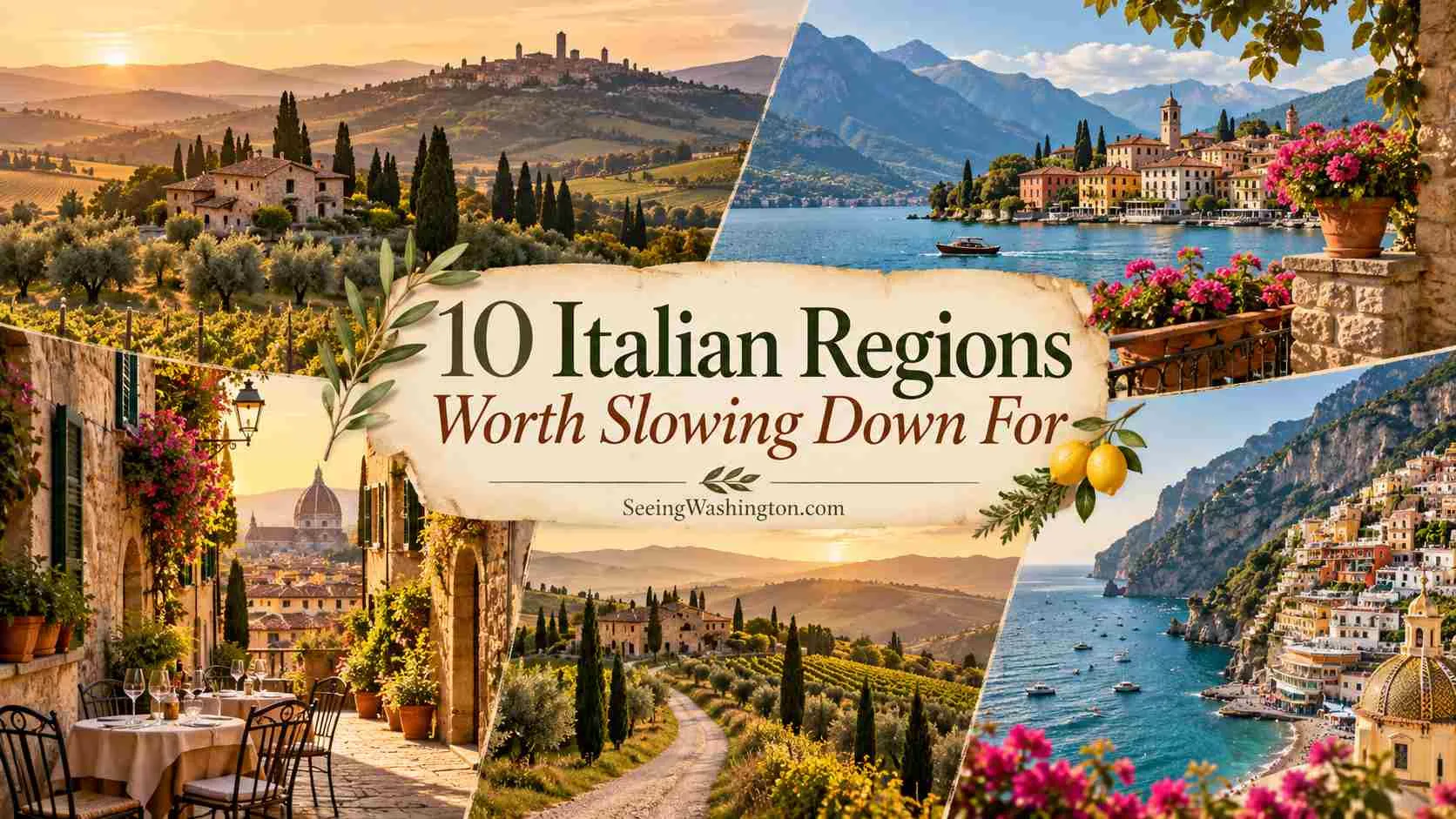
10 Italian Regions Worth Slowing Down For
Most travelers to Italy hit Rome, Florence, and Venice, spend four days feeling rushed, and leave without ever sitting still long enough to notice how different one region is from the next.
Italy isn’t one country so much as twenty distinct food cultures, dialects, and landscapes stitched together by a shared history. The Italian regions below reward a slower pace — fewer stops, longer stays, and a willingness to let an afternoon disappear over a long lunch.
Piedmont
Piedmont sits in Italy’s northwest corner, bordering France and Switzerland, and it produces some of the country’s best wine without the crowds of Tuscany. Barolo and Barbaresco vineyards blanket the hills around Alba, where truffle season runs from October through December.
Slow down here by picking one small town — La Morra or Neive — as a base and driving out to a different winery each day instead of trying to see it all.
Puglia
The heel of Italy’s boot moves at a different speed entirely, defined by whitewashed trulli houses, olive groves older than the Roman Empire, and a coastline that alternates between limestone cliffs and soft sand.
Ostuni and Alberobello draw the day-trippers, but the real pace of Puglia shows up in smaller towns like Locorotondo, where evening passeggiate still matter more than any itinerary. Seafood here is simple and immediate — raw, grilled, or barely cooked — because the ingredients don’t need much help.
Umbria
Landlocked and often overshadowed by Tuscany next door, Umbria offers the same rolling hills and medieval hill towns with a fraction of the tourist traffic. Assisi gets the pilgrims, but Spello, Todi, and Bevagna are quieter and just as beautiful, with stone streets that seem built for aimless wandering.
Umbrian food leans on lentils, black truffles, and olive oil pressed from groves you can often see from the table where you’re eating.
Sicily
Sicily is large enough that rushing through it in a week means skipping most of what makes it worthwhile. The island layers Greek ruins, Arab-Norman architecture, and Baroque towns rebuilt after the 1693 earthquake, all set against Mount Etna’s smoking presence.
Spend real time in Palermo’s markets, then head inland to towns like Modica for chocolate made with an Aztec-influenced technique that’s survived for centuries.
Le Marche
Tucked between the Apennines and the Adriatic, Le Marche remains one of Italy’s least-visited regions despite having beach towns, medieval hill villages, and the Renaissance city of Urbino within an hour of each other.
Ascoli Piceno, with its travertine stone piazzas, is arguably as handsome as any famous Tuscan town but draws a fraction of the visitors. Travelers planning Italy tours often skip this region entirely, which is exactly why it’s worth adding.
Basilicata
Basilicata is home to Matera, the cave city where people lived in stone dwellings called sassi until the 1950s, now restored into hotels and restaurants built directly into the rock.
Beyond Matera, the region is sparsely populated and mountainous, with towns like Craco standing abandoned since a 1963 landslide. It’s not a region for checklist tourism — it rewards travelers willing to drive slowly through empty landscapes and stop wherever looks interesting.
Trentino-Alto Adige
This northern region feels more Austrian than Italian in places, a legacy of its time under Habsburg rule until 1918, and that mix shows up in the food, architecture, and even the language — German is co-official alongside Italian regions.
The Dolomites offer some of the best hiking in Europe, with trails that connect one rifugio, or mountain hut, to the next. Bolzano and Merano make good bases for travelers who want mountain scenery without sacrificing good coffee and better strudel.
Calabria
At the very tip of Italy’s boot, Calabria remains largely undiscovered by international travelers despite having a coastline that rivals the Amalfi region at a fraction of the cost.
Tropea, perched on a cliff above turquoise water, has become slightly better known, but towns like Scilla remain quiet even in August. The region’s spicy ‘nduja sausage and strong culinary identity are reason enough to linger over meals.
Emilia-Romagna
Emilia-Romagna is where Parmigiano-Reggiano, prosciutto di Parma, balsamic vinegar, and Bolognese sauce all originate, making it arguably Italy’s most important food region.
Bologna deserves at least three unhurried days, but smaller cities like Modena and Parma are worth equal attention, especially for anyone willing to tour a working cheese dairy or vinegar cellar. This is a region built for eating slowly, in multiple courses, without apology.
Abruzzo
East of Rome but rarely visited by the crowds that fill the capital, Abruzzo combines the Gran Sasso mountain range with a stretch of Adriatic coast and some of the country’s most rugged national parks.
Wolves and Marsican brown bears still live in Abruzzo’s protected wilderness, a detail that surprises most visitors expecting only vineyards and ruins. Hill towns like Santo Stefano di Sessanio, nearly abandoned decades ago, have been carefully restored and now offer some of the quietest overnight stays in the country.
The common thread across all ten regions isn’t scenery — Italy has no shortage of that anywhere. It’s the absence of crowds and the presence of time, which together let you actually taste the food, talk to the people running the trattoria, and remember the trip as more than a series of photos. Pick two or three of these regions for your next trip instead of ten cities, and stay long enough in each to stop checking the map.


