
Best Cocido Gallego Near Me: Where to Find Authentic Galician Stew (2026 Guide)
Cocido Gallego is a traditional Galician stew made from slow-cooked pork parts, chickpeas, potatoes, chorizo, lacón (cured pork foreleg), grelos (Galician collard greens), and smoked ham shank — served in stages over a long, seated meal. The dish is a Galician winter specialty that originated from the November matanza (annual pig slaughter) and has been the centerpiece of Galician eating culture for centuries.
Finding the best cocido gallego near me depends on where you live. In Galicia, Spain, the town of Lalín hosts the annual Cocido Festival — the dish’s spiritual home. In Madrid, multiple traditional taverns serve cocido year-round. In the United States, Spanish and Galician restaurants in cities like New York City, Miami, and Los Angeles carry the dish seasonally, though availability varies by location and time of year.
This guide covers what makes authentic cocido gallego different from imitations, which ingredients define a real version, where to find it in Spain and the US, what to look for in a restaurant, and how to make it at home using a traditional recipe.
What Is Cocido Gallego?
Cocido Gallego is a slow-cooked one-pot meal from Galicia in northwestern Spain, built around multiple cuts of pork, chickpeas (garbanzos), potatoes, and greens — served in 3 separate courses: broth first, then vegetables, then meat.
The word “cocido” translates to “cooked.” The dish traces its origins to some of the earliest forms of cooking — a pot of water over a fire, filled with whatever meat, roots, and leaves were available. The Galician version stands out from other Spanish cocidos because of its heavy reliance on the pig. From snout to tail, Galicians traditionally used every part of the animal after the November matanza — the annual slaughter that supplied preserved pork for the entire winter.
As food writer Noah Chichester documented in his writing for Wines of Galicia, the dish is inseparable from its cultural context. Chichester described being served cocido at a family friend’s son’s second birthday in Galicia — plate after plate of every pork cut imaginable, followed by garbanzos, boiled potatoes, grelos, chorizo sausages, massive hunks of bread, and enough wine to wash it all down. The Galician approach to cocido is not a meal. It is an event.
Key Ingredients in Authentic Cocido Gallego
An authentic cocido gallego contains a minimum of 8 core ingredients — each one serving a specific role in the final dish.
| Ingredient | Role in the Dish | Notes |
|---|---|---|
| Lacón (cured pork foreleg) | Primary meat — smoky, tender after hours of boiling | Cured similarly to jamón, but boiled instead of eaten raw |
| Chorizo | Adds paprika spice and fat to the broth | Spanish-style cured chorizo, not Mexican chorizo |
| Spare ribs | Provides bone-based richness to the broth | Cut into 3 sections for even cooking |
| Pig ears | Adds gelatinous texture | Sliced after cooking |
| Smoked ham shank | Deep smoky flavor base | Sometimes substituted with smoked pork neck |
| Garbanzos (chickpeas) | Absorb meat flavor, provide body | Soaked 12 hours before cooking |
| Potatoes | Starchy balance to the rich meat | Whole, peeled, added during the final cooking stage |
| Grelos (collard greens) | Bitter, earthy green that cuts through the fat | Galician grelos have their own designation of origin |
Additional ingredients found in many traditional recipes include pig snout, smoked pork neck, lard, bread, anchovies, cheese, olives, and ham served as starters before the main cocido arrives.
The three-meat ladle — pork, chorizo, and smoked ham — defines the dish. Remove any one of these 3 elements and the cocido loses its character.
Where to Find the Best Cocido Gallego Near me in Spain
The best cocido gallego in Spain is found in 3 regions: the town of Lalín (the dish’s spiritual home), Santiago de Compostela (the Galician capital), and Madrid (where traditional cocido restaurants serve it year-round).

Lalín — The Cocido’s Spiritual Home
Lalín in Galicia hosts the annual Cocido Festival — a multi-day event with a parade, a meat auction, and a pig mascot named Son de Lalín who wears a sign reading “I’m From Lalín.”
The Cocido Festival in Lalín is the single largest celebration of the dish anywhere in the world. The town takes cocido seriously enough that the festival includes floats dedicated to each individual ingredient of the stew. The mayor’s pet pig — strictly off the menu — serves as the festival mascot.
Noah Chichester described attending a “small” cocido gathering in Lalín with his friend Carlos (called “Joe” by everyone for reasons never fully explained) — a private student he met while working as an English teacher in Galicia. The gathering included 30 people. Carlos considered that “keeping it on the small side.”
The Cocido Festival typically runs in February. Restaurant availability for cocido in Lalín extends from January through the beginning of Lent.
Santiago de Compostela
Santiago de Compostela offers cocido gallego at traditional Galician taverns throughout the winter season. The Compostela market style of cocido features locally sourced grelos and pork, and restaurants in the old town frequently list cocido as a seasonal daily special.
Cocido in Santiago de Compostela tends to follow the traditional multi-course serving format: sopa de cocido (broth) first, then chickpeas and potatoes, then the meats arranged on a separate plate.
Madrid — Best Cocido en Madrid
Madrid serves cocido madrileño — a close cousin of cocido gallego that uses similar ingredients but often includes beef and blood sausage. Several traditional restaurants in Madrid serve both madrileño and gallego versions.
For the Galician-specific version, seek restaurants with explicit Galician identity or chefs from Galicia. The distinction matters because cocido madrileño and cocido gallego differ in their grelos content, pork-to-beef ratio, and serving structure.
How to Find the Best Cocido Gallego Near Me in the United States
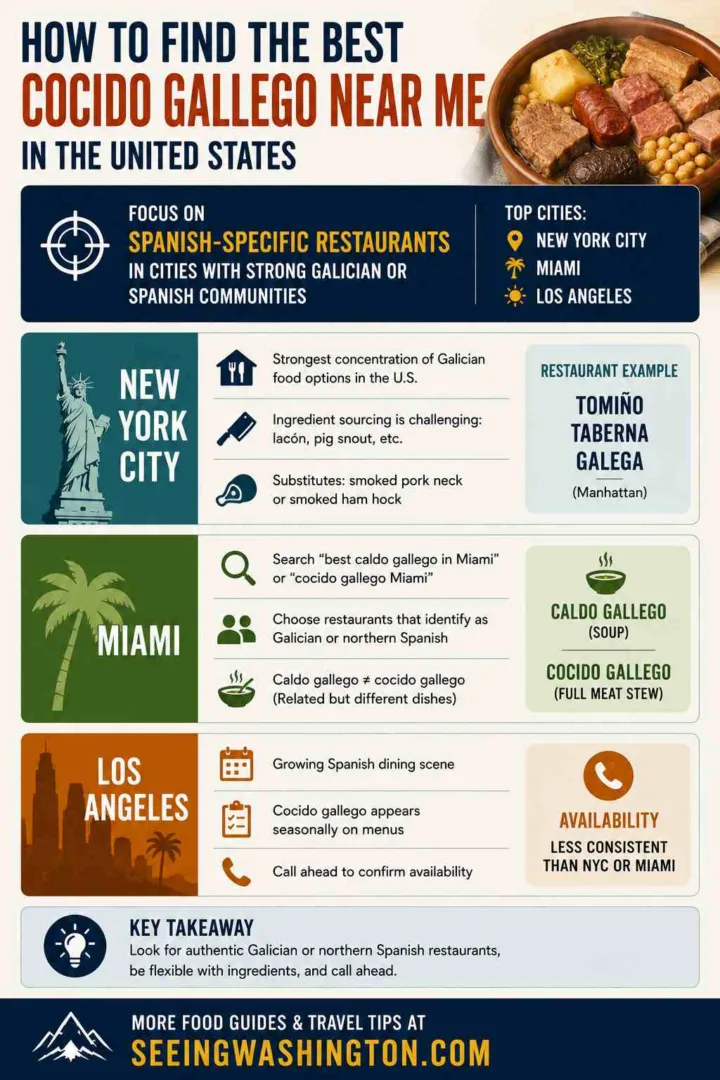
Finding authentic cocido gallego in the United States requires targeting Spanish-specific restaurants in cities with strong Galician or Spanish immigrant communities — primarily New York City, Miami, and Los Angeles.
New York City
New York City has the strongest concentration of Galician food options in the United States. Restaurants like Tomiño Taberna Galega serve Galician dishes with traditional preparation methods. Noah Chichester documented his own attempt to recreate cocido in his New York City apartment — sourcing pig ears from a butcher, smoked pork neck from a Greek market two avenues away, and searching unsuccessfully for pig snout across multiple neighborhoods and an Italian salumeria.
The challenge in New York City (and most US cities) is ingredient sourcing. Lacón is not commonly stocked in American grocery stores. Substitutes include smoked pork neck or smoked ham hock, which provide similar smoky depth without the exact same cured-foreleg texture.
Best Caldo Gallego in Miami
Miami’s Spanish-speaking population supports multiple restaurants serving Galician and broader Spanish cuisine. Search for “best caldo gallego in Miami” or “cocido gallego Miami” and filter by restaurants that specifically identify as Galician or northern Spanish — not just generic “Spanish” establishments.
Caldo gallego (Galician broth) and cocido gallego are related but distinct dishes. Caldo gallego is a lighter bean-and-greens soup. Cocido gallego is a full multi-course meat stew. Restaurants that understand the difference are more likely to prepare authentic versions of both.
Best Cocido Los Angeles
Los Angeles has a growing Spanish dining scene. Cocido gallego appears seasonally on menus at restaurants specializing in regional Spanish cuisine. The availability is less consistent than New York City or Miami, so calling ahead to confirm the dish is on that day’s menu is the practical approach.
How to Identify an Authentic Restaurant (Anywhere)
An authentic cocido gallego restaurant demonstrates 4 specific qualities that separate real preparation from simplified imitations.
| Quality | What It Signals |
|---|---|
| Cocido served in separate courses (broth, then vegetables, then meat) | Traditional Galician serving method — not everything mixed in one bowl |
| Multiple pork cuts on the plate (lacón, chorizo, ribs, ear) | Real cocido uses the whole pig — a single pork cut means it is simplified |
| Grelos present alongside potatoes and chickpeas | Grelos are the defining green in Galician cocido — cabbage alone is not the same |
| Cocido available only seasonally or on specific days | Authentic restaurants treat cocido as a slow-cooked event dish, not a daily menu item |
Restaurants that serve cocido gallego as a quick lunch special available every day of the week are likely using simplified preparation. Traditional cocido takes 3 to 4 hours of cooking time and is typically prepared in batches.
What to Expect When Ordering Cocido Gallego
Cocido gallego is served in 3 stages over a seated meal that lasts 1 to 2 hours minimum — this is not a fast-casual dining experience.
Course 1 — Sopa de Cocido (The Broth)
The meal begins with sopa de cocido — a golden, deeply flavored broth pulled directly from the cooking pot. The broth carries the combined essence of every meat, bone, and vegetable that has simmered for hours. The sopa de cocido clarity depends on how carefully the cook has skimmed fat during the cooking process.
Course 2 — Vegetables and Chickpeas
The second course brings boiled potatoes, garbanzos (chickpeas), and grelos. The chickpeas absorb the pork-infused broth during cooking, which gives them a garbanzo skin tenderness and depth that plain boiled chickpeas cannot replicate. The grelos provide a grelo bitterness balance — a green, earthy counterpoint to the richness of the meat courses.
Course 3 — The Meats
The final course is the centerpiece. Plates arrive piled with lacón (falling off the bone), sliced chorizo with an artisan chorizo snap when cut, spare ribs, pig ears sliced thin, and smoked ham shank. The slow-cooked cartilage richness from the ears and the pork shoulder melt from the lacón create a range of textures across a single plate.
As Milagros (Joe’s mother in Lalín) demonstrated in Chichester’s account, the Galician approach to serving is aggressive generosity. “Veña, un pouquiño máis” — “Come on, just a tiny bit more” — using the diminutive of the diminutive to describe the next enormous helping being placed on the plate.
Traditional Cocido Gallego Recipe
This cocido gallego recipe serves 6 to 8 people and requires 3 to 4 hours of cooking time, plus 12 hours of overnight soaking for the chickpeas.
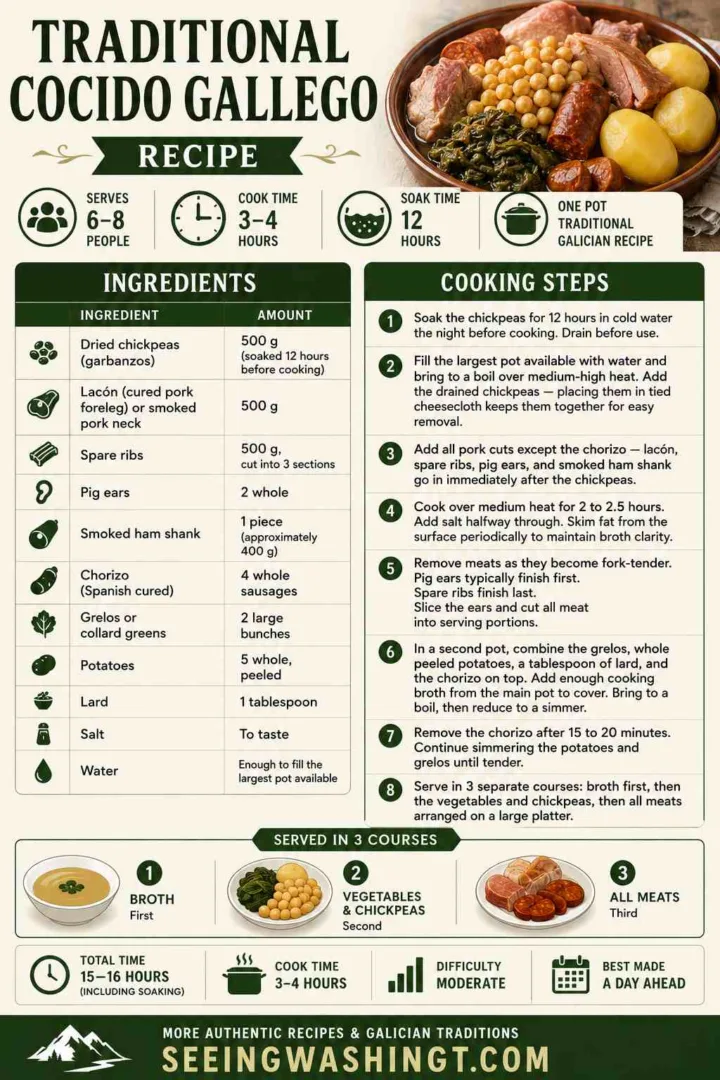
Adapted from traditional Galician home recipes and Milagros’s method documented by Noah Chichester.
Ingredients
| Ingredient | Amount |
|---|---|
| Dried chickpeas (garbanzos) | 500 g (soaked 12 hours before cooking) |
| Lacón (cured pork foreleg) or smoked pork neck | 500 g |
| Spare ribs | 500 g, cut into 3 sections |
| Pig ears | 2 whole |
| Smoked ham shank | 1 piece (approximately 400 g) |
| Chorizo (Spanish cured) | 4 whole sausages |
| Grelos or collard greens | 2 large bunches |
| Potatoes | 5 whole, peeled |
| Lard | 1 tablespoon |
| Salt | To taste |
| Water | Enough to fill the largest pot available |
Cooking Steps
- Soak the chickpeas for 12 hours in cold water the night before cooking. Drain before use.
- Fill the largest pot available with water and bring to a boil over medium-high heat. Add the drained chickpeas — placing them in tied cheesecloth keeps them together for easy removal.
- Add all pork cuts except the chorizo — lacón, spare ribs, pig ears, and smoked ham shank go in immediately after the chickpeas.
- Cook over medium heat for 2 to 2.5 hours. Add salt halfway through. Skim fat from the surface periodically to maintain broth clarity.
- Remove meats as they become fork-tender. Pig ears typically finish first. Spare ribs finish last. Slice the ears and cut all meat into serving portions.
- In a second pot, combine the grelos, whole peeled potatoes, a tablespoon of lard, and the chorizo on top. Add enough cooking broth from the main pot to cover. Bring to a boil, then reduce to a simmer.
- Remove the chorizo after 15 to 20 minutes. Continue simmering the potatoes and grelos until tender.
- Serve in 3 separate courses: broth first, then the vegetables and chickpeas, then all meats arranged on a large platter.
Wine Pairing Notes
Sommelier Carlota Cabanas of Restaurante Cabanas in Lalín recommends pairing cocido with a light red that cuts through the fatty meats — specifically a Caíño Tinto, which refreshes the palate between bites. Phil Gonzalez of Tomiño Taberna Galega in New York City suggests a light-bodied, high-acid red like a Goliardo Tinto or a rounder Escolma Tinto from Ribeiro.
The general principle: choose wines with good acidity that cut through the fat of the cocido, rather than heavy tannic reds that compete with the pork.
Cocido Gallego vs Caldo Gallego vs Cocido Madrileño
These 3 dishes share a common family tree but differ in ingredients, serving style, and origin — confusing them leads to ordering the wrong dish.
| Feature | Cocido Gallego | Caldo Gallego | Cocido Madrileño |
|---|---|---|---|
| Origin | Galicia, northwestern Spain | Galicia, northwestern Spain | Madrid, central Spain |
| Primary Protein | Multiple pork cuts (lacón, ribs, ears, chorizo) | Usually just ham bone or chorizo | Pork, beef, and chicken |
| Legume | Chickpeas (garbanzos) | White beans | Chickpeas (garbanzos) |
| Greens | Grelos (Galician turnip greens) | Grelos or cabbage | Cabbage |
| Serving Style | 3 separate courses (broth, vegetables, meats) | Single bowl — soup format | 3 separate courses |
| Blood Sausage | Not traditional | Not traditional | Common inclusion |
| Meal Size | Full multi-hour meal event | Standard soup serving | Full multi-hour meal |
Search queries for “best caldo gallego near me” and “best cocido near me” often overlap, but the two dishes are meaningfully different. Caldo gallego is a lighter soup. Cocido gallego is a full-scale feast.
The Cultural Meaning Behind Cocido Gallego
Cocido gallego is not a recipe — it is the centerpiece of Galician eating culture, tied to the matanza, morriña, and the Galician identity of communal abundance.
The dish’s roots sit in the annual November matanza — the pig slaughter that supplied preserved pork through winter. Every part of the pig was salted, smoked, or stuffed. These preserved cuts then became the building blocks of cocido during the months between January and Lent.
Morriña — the Galician word for the deep nostalgia felt when away from terras Galegas (Galician lands) — is closely associated with cocido. Galician emigrants worldwide recreate the dish as a way to carry their homeland with them. Chichester described his own New York City cocido attempt as “a mix of equal parts nostalgia and curiosity,” referencing the Julie and Julia spirit of recreating something deeply personal in a foreign kitchen.
In Lalín during the Cocido Festival, the dish becomes civic identity. The parade features floats for each ingredient. The meat auction is a public event. The mayor’s pet pig — Son de Lalín — runs around wearing a sign that says “I’m From Lalín,” strictly off the menu and treated like a family member.
The Galician approach to the meal itself reflects a cultural value: forced generosity. As Chichester wrote, “Galicians are happiest when they’re forcing others to eat.” The portions are deliberately enormous. Saying no is treated as a suggestion. The diminutive of the diminutive — “un pouquiño máis” — is used to describe a serving that could feed a second person.
Frequently Asked Questions
Where can I find the best cocido gallego near me?
Search for restaurants that specifically identify as Galician or northern Spanish in your city. In the United States, New York City, Miami, and Los Angeles have the strongest concentration of Spanish restaurants likely to carry cocido gallego. In Spain, Lalín, Santiago de Compostela, and Madrid are the primary cities. Call ahead, as cocido is typically a seasonal or weekly special.
What is the difference between cocido gallego and caldo gallego?
Cocido gallego is a full multi-course meat stew served in 3 stages. Caldo gallego is a lighter bean-and-greens soup served in a single bowl. Cocido uses chickpeas and multiple pork cuts. Caldo uses white beans and typically includes less meat.
What does cocido gallego taste like?
Cocido gallego tastes deeply smoky from the cured and smoked pork, earthy from the grelos, and rich from the chickpeas that absorb hours of pork-infused broth. The chorizo adds a paprika oil swirl of spice. The overall flavor profile is hearty, savory, and layered with fat-forward richness balanced by the bitter greens.
Can I make cocido gallego at home?
Yes, but the process takes 3 to 4 hours of active cooking plus 12 hours of chickpea soaking. The main challenge outside of Spain is sourcing lacón (cured pork foreleg). Smoked pork neck or smoked ham hock serve as workable substitutes available at most butcher shops and specialty markets.
Is cocido gallego available for delivery?
Cocido gallego is rarely available for delivery because the dish is traditionally served in 3 separate courses and does not transport well in combined containers. Some restaurants may offer cocido gallego takeout as a single container, but the multi-course experience — sopa de cocido, then vegetables, then meats — is best experienced seated in the restaurant.
When is cocido gallego season?
Cocido gallego is traditionally eaten from January through the beginning of Lent (typically late February or early March). The annual Cocido Festival in Lalín takes place in February. Some restaurants in Madrid and large Spanish cities serve cocido year-round, but the traditional season is winter only.
Final Assessment
Cocido gallego is one of the few dishes that functions as both a meal and a cultural statement. The search for “best cocido gallego near me” is really a search for 2 things at once — a restaurant that serves it authentically, and the experience that surrounds it. The broth, the meats, the grelos, the forced second helpings, and the 3-hour seated meal are all part of what makes cocido gallego more than food.
In Galicia, the dish is identity. Outside of Galicia, it is morriña made edible — a way to bring terras Galegas to wherever you are. Finding a good version near you starts with knowing what the real thing looks like, asking the right questions about preparation, and accepting that the best cocido gallego is never a fast meal.


