
Seattle to Miami Drive: Distance, Time & Road Trip Guide
I’ll give you the honest answer first: the Seattle to Miami drive is one of the longest road trips you can make within the United States, and most people who look it up end up flying. But if you want to do it — really do it — it’s one of the great American road trips. I’ve broken down everything you need to know before you commit.
The drive from Seattle, Washington to Miami, Florida covers approximately 3,300 miles and takes between 44 and 48 hours of total drive time. Most people spread this across 5 to 7 days. The most direct route follows Interstate 90 east out of Seattle, then drops south through the middle of the country before connecting to I-95 south into Miami, Florida. Depending on your route choice, you’ll pass through Missouri, Kansas, Tennessee, Georgia, or a dozen other states.
According to Travelmath and Wanderlog, there’s no single “correct” route — this is a coast-to-coast drive and the country is wide. This guide covers the 2 most practical routes, 7 stops worth making, the full drive time breakdown, and the real answer to whether you should fly instead.

How Far Is Seattle to Miami by Car?
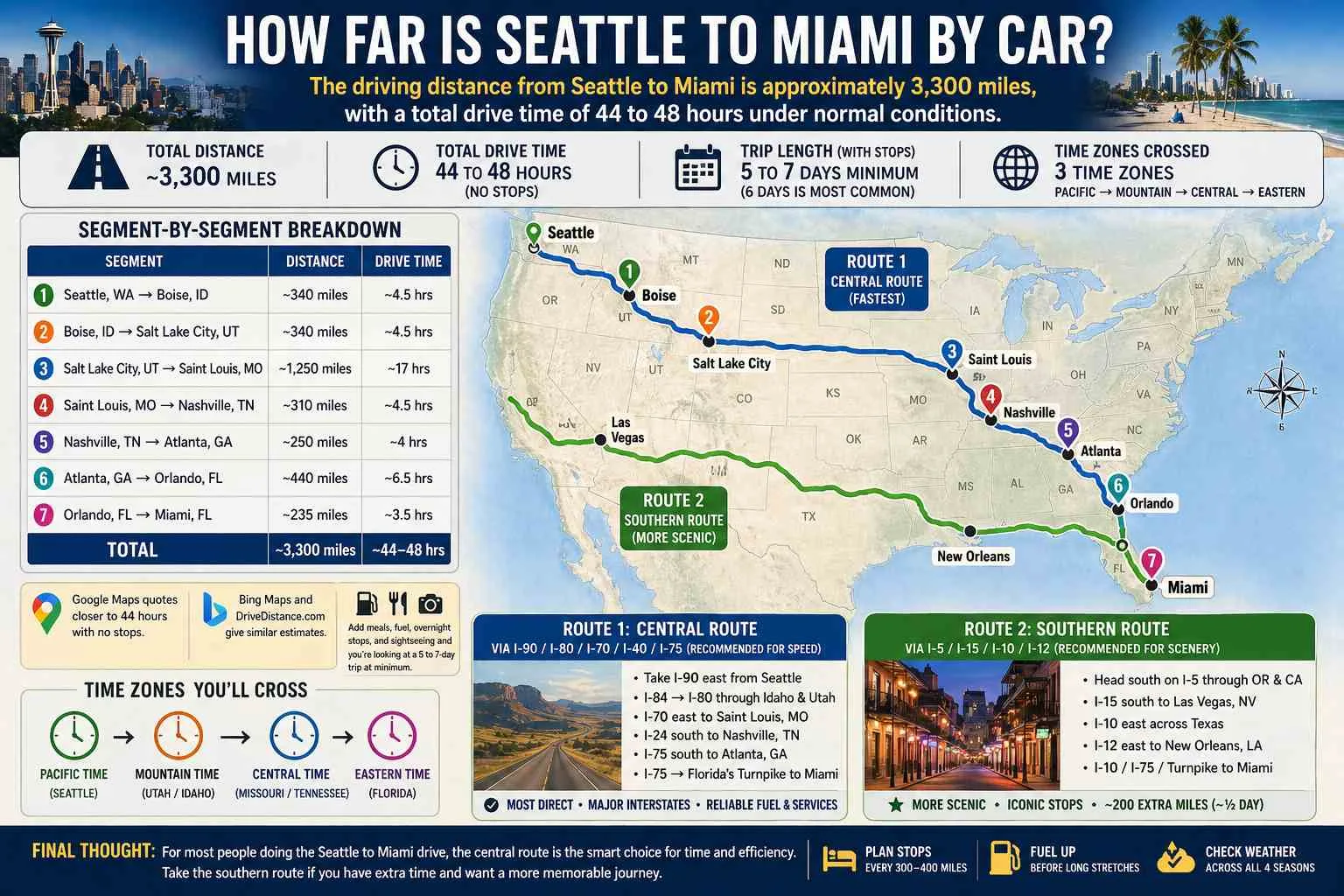
The driving distance from Seattle to Miami is approximately 3,300 miles, with a total drive time of 44 to 48 hours under normal conditions.
Google Maps quotes closer to 44 hours with no stops. Bing Maps and DriveDistance.com typically give similar estimates. Add meals, fuel, overnight stops, and any sightseeing and you’re looking at a 5 to 7-day trip at minimum — 6 days is the most common plan for people doing it comfortably.
Here’s a segment-by-segment breakdown of the most direct central route:
| Segment | Distance | Drive Time |
|---|---|---|
| Seattle, WA → Boise, ID | ~340 miles | ~4.5 hrs |
| Boise, ID → Salt Lake City, UT | ~340 miles | ~4.5 hrs |
| Salt Lake City, UT → Saint Louis, MO | ~1,250 miles | ~17 hrs |
| Saint Louis, MO → Nashville, TN | ~310 miles | ~4.5 hrs |
| Nashville, TN → Atlanta, GA | ~250 miles | ~4 hrs |
| Atlanta, GA → Orlando, FL | ~440 miles | ~6.5 hrs |
| Orlando, FL → Miami, FL | ~235 miles | ~3.5 hrs |
| Total | ~3,300 miles | ~44–48 hrs |
You also cross 3 time zones going from Pacific Time in Seattle to Eastern Time in Miami — worth accounting for when you’re planning drive windows and booking hotels.
The 2 Best Routes: Central vs. Southern
The 2 main routes for the Seattle to Miami drive are the central route through Saint Louis and Nashville, and the southern route through Las Vegas and New Orleans — and the central route is faster while the southern route is more scenic.
Route 1: Central Route via I-90 / I-80 / I-40 (Recommended for Speed)
This is the most direct option. You leave Seattle on I-90 east, cut through Idaho and Utah, then pick up I-70 east toward Saint Louis, Missouri. From Saint Louis you head south on I-24 through Nashville, Tennessee, then I-75 south through Atlanta, Georgia, and finally I-75 / Florida’s Turnpike into Miami. This route keeps you on major interstates the entire way with reliable fuel and services.
Route 2: Southern Route via Las Vegas and New Orleans (Recommended for Scenery)
This adds roughly 200 miles and half a day but takes you through the American Southwest. You go south from Seattle through Oregon and California, cut east through Las Vegas, cross into Texas, and come up through New Orleans before the final run into Florida. Brad C., who drove this route in 2022 specifically to see the French Quarter, said it’s the only way he’d do the trip again. The mileage penalty is real, but the stops are better.
For most people doing the trip once, the southern route gives you more to see. For people relocating or moving vehicles, the central route is faster and more efficient.
Best Stops on the Seattle to Miami Drive
The 7 best stops on the Seattle to Miami road trip are Boise (Idaho), Salt Lake City (Utah), Saint Louis (Missouri), Kansas City (Missouri), Nashville (Tennessee), Atlanta (Georgia), and Orlando (Florida).
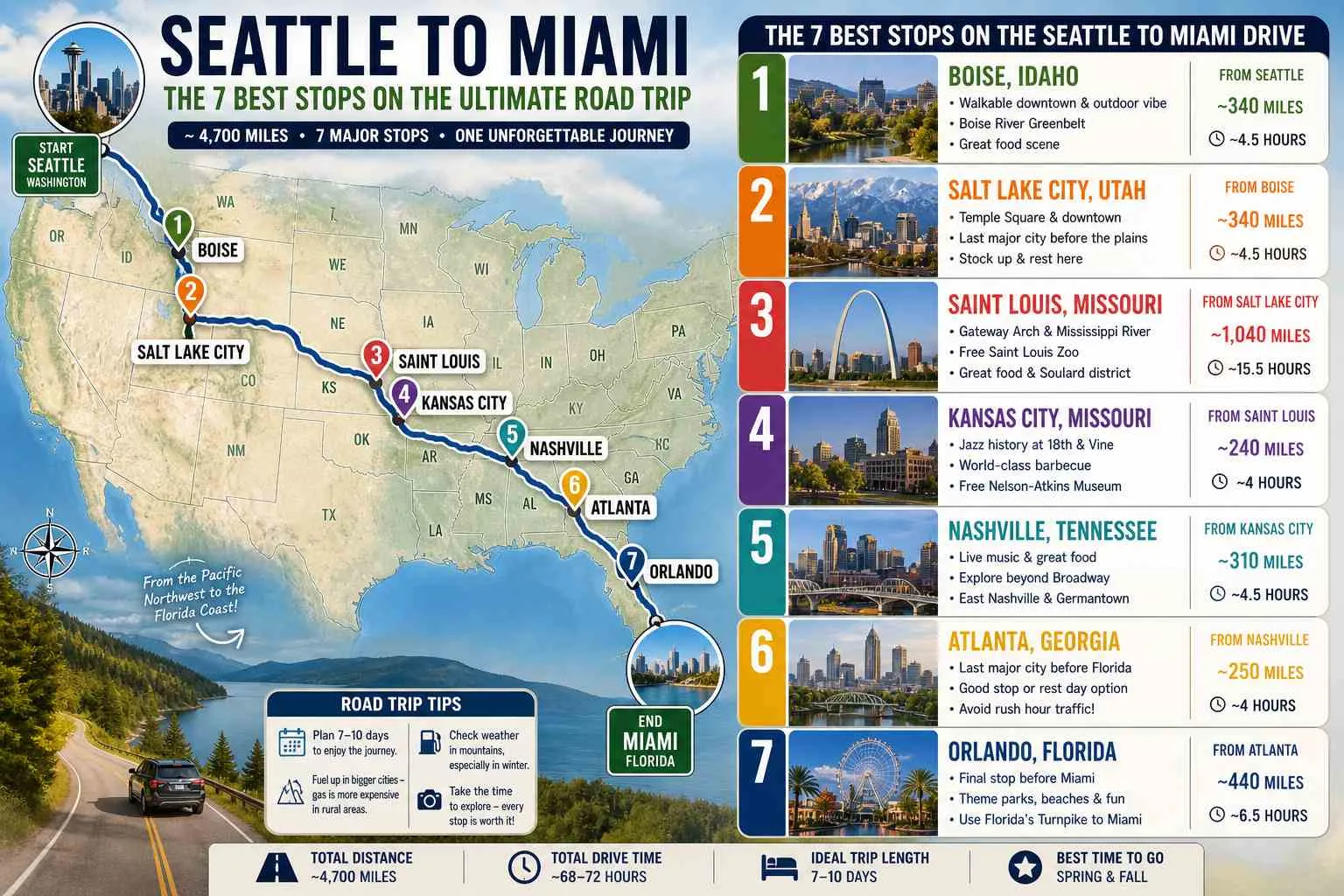
Not every stop needs a full day. Some are overnight fuel breaks; others deserve 24 hours. Here’s what each is actually worth.
Boise, Idaho — Day 1 Stop
Boise sits about 340 miles east of Seattle and makes a clean first-day stop after roughly 4.5 hours of driving.
After years of treating Boise as a pass-through, I finally stopped for a night in 2022 and was genuinely surprised. It’s a walkable, outdoor-oriented city with a food scene that overdelivers for its size. The Boise River Greenbelt runs through the city center — a good evening walk after a full day in the car.
Practical info:
- Location: Boise, Idaho — I-84 corridor
- Best for: First overnight stop, dinner, morning run before continuing
- Tip: Stay near downtown rather than at a highway exit hotel — the difference in experience is worth the minor extra cost
My honest take: Boise is the stop most Seattle-to-Miami road trip guides skip or mention once and move on. That’s a mistake. Give it a night and you’ll start day 2 in a better mood than if you’d pushed to Salt Lake City.
Salt Lake City, Utah — Day 2 Stop
Salt Lake City sits about 680 miles from Seattle and works as either a day 2 stop or a day 1 push if you’re driving long first-day hours.
The city itself has more personality than I expected when I first drove through in 2021. Downtown has legitimate restaurants, and if you have a morning to spare, the area around Temple Square is worth walking. Garrett V., who’s done cross-country drives 4 times, always stops in Salt Lake City and always stays at least one night.
From Salt Lake City east, you’re committing to the long interior of the country. Stock up on anything you need here — it’s your last major city before the Great Plains section begins.
Practical info:
- Location: Salt Lake City, Utah — I-15 / I-80 junction
- Parking: Easy and inexpensive outside downtown
- Best for: Overnight stop, real meal, gear resupply
- Tip: Book your hotel in advance — Salt Lake City is a hub for regional travelers and rooms fill on weekend nights
My honest take: Salt Lake City is strategically the most important stop on the central route. It’s the last major urban center before a long, flat run east. Don’t rush through it.
Saint Louis, Missouri — The Midpoint Stop
Saint Louis, Missouri marks roughly the geographic midpoint of the Seattle to Miami drive and is the most significant cultural stop on the central route.
The Gateway Arch sits on the western bank of the Mississippi River and is genuinely worth an hour of your time — the tram ride to the top gives you a view of the river and the Missouri flatlands that you won’t get from the highway. Lewis and Clark launched their expedition west from this riverbank.
Beyond the Arch, Saint Louis Zoo is free and one of the best in the United States. The Soulard neighborhood has good bars and live music. Chris C. stopped in Saint Louis on his coast-to-coast drive and ended up staying two nights — said the city held up far better than he expected.
The Abraham Lincoln Presidential Library and Museum is a few hours north in Springfield, Illinois, if you want to add a half-day detour before crossing into Missouri.
Practical info:
- Location: Saint Louis, Missouri — I-70 / I-64 junction
- Best for: Midpoint overnight, Gateway Arch visit, Soulard dinner
- Tip: Park near the Arch early — the tram has limited capacity and lines build by late morning
My honest take: Saint Louis gets underrated on road trip lists because it sits in the middle of the country and people are focused on either coast. That’s a mistake. It’s a real city with a real identity, and the Arch earns its reputation.
Kansas City — Jazz, Barbecue, and an Easy Half-Day
Kansas City, Missouri sits about 4 hours west of Saint Louis and is worth a detour or overnight if you’re taking the I-70 route across Missouri.
The 18th & Vine Jazz District is the reason most people stop — the American Jazz Museum and the Negro Leagues Baseball Museum sit on the same block and both run deeper than you’d expect. The Nelson-Atkins Museum of Art is free and holds a serious permanent collection. And if you’re going to eat barbecue anywhere on this drive, Kansas City is the place.
The Kauffman Center for the Performing Arts anchors the downtown arts scene if you’re in town for an evening. Amanda W. stopped in Kansas City on her cross-country move and said the barbecue alone was worth the detour.
Practical info:
- Location: Kansas City, Missouri — I-70 / I-35 junction
- Best for: Jazz history, barbecue lunch, half-day or full overnight
- Tip: The 18th & Vine district is 10 minutes from downtown — easy to add without rerouting significantly
My honest take: Kansas City is the stop that surprises people most on this route. Nobody expects a city this good in the middle of Kansas and Missouri. The barbecue is real, the jazz history is deep, and the museums don’t feel like tourist obligations.
Nashville, Tennessee — The Easy Crowd-Pleaser
Nashville sits about 310 miles south of Saint Louis on I-24 and is the most popular overnight stop on the southeastern leg of this drive.
I’ve been to Nashville 3 times now and it earns its reputation — but go in with specific plans or it turns into a Broadway bar crawl by default. The actual interesting parts of Nashville are outside the neon strip: East Nashville for food, the Parthenon in Centennial Park, and the side streets of Germantown. Jen S. drove through Nashville in 2023 and said she wished she’d stayed longer specifically to get off Broadway and into the neighborhoods.
For a cross-country drive, Nashville works as a night 4 or night 5 stop depending on your pace.
Practical info:
- Location: Nashville, Tennessee — I-24 / I-40 junction
- Parking: Use a garage downtown — street parking disappears fast on weekends
- Best for: Evening out, overnight, good food before the Georgia stretch
- Tip: Book hotels early — Nashville is one of the most booked weekend cities in the American South
My honest take: Nashville is good but slightly over-indexed for the bachelor party crowd on Broadway. If you’re driving cross-country, treat it as a real city stop — East Nashville and Germantown reward anyone who walks past the neon.
Atlanta, Georgia — Gateway to Florida
Atlanta is roughly 250 miles south of Nashville on I-75 and is the last major city before you enter Florida.
It’s a logical overnight if you want to break the Florida approach into 2 days rather than doing Orlando and Miami back-to-back. Julie G., who relocated from Seattle to Miami in 2022, told me she stopped in Atlanta both for practical reasons and because she’d never been — she ended up spending a full day there and said Chattanooga, Tennessee about 2 hours north, was a better stop if you have to choose one.
Practical info:
- Location: Atlanta, Georgia — I-75 / I-285 junction
- Best for: Final overnight before Florida, fuel, rest day option
- Tip: Avoid driving through Atlanta between 7–9 AM or 4–7 PM — the traffic is genuinely one of the worst choke points on this route
My honest take: Atlanta is a big city with a traffic problem. Time your arrival outside rush hour without exception. If you’re flexible on timing, consider Chattanooga as an overnight instead — smaller, easier, and the Tennessee Aquarium is genuinely worth it.
Orlando and Tampa, Florida — The Final Florida Stretch
Orlando sits 440 miles south of Atlanta and marks the beginning of the final Florida leg before Miami — about 3.5 hours from the end of the drive.
Tampa and Sarasota are on the Gulf Coast if you prefer a west-side approach down through Florida’s Turnpike. Clearwater is 90 minutes from Orlando and one of the better beaches on the Gulf if you want to pause before the last push. Most people coming from Atlanta take I-75 south through Tampa or stay on I-95 down the Atlantic coast — both get you to Miami in roughly the same time.
St. Augustine, Florida is on the Atlantic coast route and worth a 2-hour stop — it’s the oldest city in the United States and the historic district is walkable and distinctive.
Practical info:
- Location: Orlando, Florida — I-4 / Florida’s Turnpike junction
- Best for: Final overnight, park visit if you have kids, last fuel before Miami
- Tip: Florida’s Turnpike is the fastest run from Orlando to Miami — pay the tolls and don’t fight it
My honest take: By the time you’re in Orlando, you’re almost done. The temptation to rush the last 235 miles into Miami is real. Resist it if you can and stop somewhere on the coast — you’ve driven 3,000 miles. A beach stop before the finish line is earned.
Should You Fly or Drive Seattle to Miami?
Flying is faster and usually cheaper than driving Seattle to Miami for most travelers, but the drive makes sense for 4 specific situations.
Direct flights from Seattle-Tacoma International Airport to Miami International Airport run approximately 5 to 5.5 hours in the air. With airport time, the total door-to-door window is around 8 to 9 hours. Compare that to 5 to 7 days of driving.
Fly if: You have limited time, you’re traveling solo without a vehicle relocation reason, or you’re price-sensitive — fuel costs alone for 3,300 miles in an average car run $350 to $500 depending on gas prices, plus hotels for 5 to 6 nights.
Drive if: You’re relocating and moving a vehicle, you want the experience of crossing the country, you’re traveling with family and flying costs multiply, or you genuinely love road trips and have the time.
The flight time from Seattle to Miami direct is about 5 hours and 30 minutes. Non-stop routes on multiple airlines operate this corridor daily. If time is your constraint, fly.
Seattle to Miami Drive: Time Zone and Fuel Planning
The Seattle to Miami drive crosses 3 time zones — Pacific, Mountain, Central, and Eastern — which means you gain 3 hours traveling east.
That time gain is useful when planning. Leaving Seattle at 6 AM Pacific gives you an effective arrival in Miami territory of 9 PM Eastern — but only if you’re driving 44 straight hours, which nobody should do.
Fuel cost estimate for Seattle to Miami: At 3,300 miles, a car averaging 30 mpg uses roughly 110 gallons. At $3.50 per gallon national average, that’s approximately $385 in fuel. An SUV at 22 mpg burns around 150 gallons — closer to $525. Add 5 to 6 nights of hotels at $100 to $150 per night and the total trip cost reaches $900 to $1,400 before food.
Use MapQuest or Wanderlog’s road trip planner to get a personalized fuel cost estimate based on your specific vehicle and current gas prices.
6 Things I’ve Learned About Long Cross-Country Drives
1. Never drive more than 8 to 9 hours in a single day. Past hour 8, your reaction time degrades and the miles stop being enjoyable. The country is too big to rush.
2. Book hotels before you leave, not the night before. On popular routes through Nashville and Atlanta especially, last-minute hotel rooms either don’t exist or cost 3 times the normal rate.
3. The middle of the country is longer than it looks on a map. Missouri and Kansas between Salt Lake City and Saint Louis is genuinely 17 hours of driving across 2 days. Respect the distance.
4. Check your tire pressure and oil before you leave Seattle. Not in Salt Lake City. Before you leave. A 3,300-mile drive surfaces any maintenance issues that have been quietly brewing.
5. Download offline maps before crossing rural areas. Cell service disappears across parts of Wyoming, Utah, and interior Missouri. Google Maps offline mode works well — set it up at your hotel the night before.
6. The Southeast in summer is brutal heat. If you’re doing this drive between June and August, your Atlanta-to-Miami stretch will be 95°F with humidity. Keep water in the car and service your AC before you leave.
Final Thoughts
The Seattle to Miami drive is 3,300 miles of the United States spread across a week of your life. I won’t tell you it’s easy or that everyone should do it. Most people should fly.
But for the people who want to drive it — who want to watch the Pacific Northwest give way to the Rocky Mountains, then the Great Plains, then the American South, then the heat and light of Florida — there’s nothing else like it. You cross every kind of American terrain and every kind of American city. You earn Miami in a way that a 5-hour flight doesn’t give you.
If you’re starting your trip from Seattle and want to know the city before you leave it — or if you’re ending a round trip back here — I’ve got a full local guide covering everything Seattle has to offer before you hit the road. And if you’re considering the drive in the other direction or exploring the Pacific Northwest leg of the trip, the beaches around Seattle are worth one last stop before you point the car east.
Drive safe. The country is worth seeing.


